
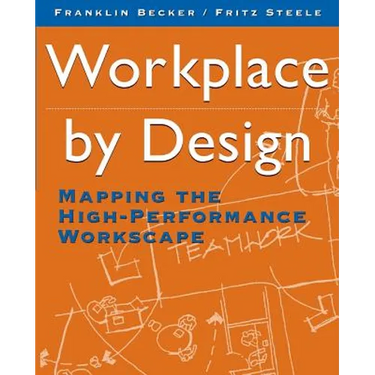


Workplace by Design: Mapping the High-Performance Workscape - Paperback
 Workplace by Design: Mapping the High-Performance Workscape - Paperback
$52.36
/
Workplace by Design: Mapping the High-Performance Workscape - Paperback
$52.36
/

products.product.pickup_availability.unavailable

Your payment information is processed securely. We do not store credit card details nor have access to your credit card information.


by Franklin Becker (Author), Fritz Steele (Author)
Create workspace that supports business strategies
Space is an organization's second most valuable asset. Yet littleattention is paid to how it supports the new ways in which today'sorganizations operate---teamwork, flattened hierarchies, telecommuting, collaborating across functions. Workplace by Designshows CEOs and managers alike how to put aside and rethinkconventional, awkward notions of space utilization based onhierarchy and status--notions that pit people against each other inturf wars, tear apart teams, and tie up company cash. Usingillustrative examples from Digital Equipment Corporation, Steelcase, and others, the authors show how team environments, non-territorial offices and other strategies can support businessobjectives, energize employees, and produce a more competitiveorganization.Front Jacket
When Hurricane Andrew smashed through Burger King's world headquarters in Miami, it destroyed "Mahogany Row," a floor of imposing executive suites. In the aftermath, everyone from managers and telephone operators to the CEO found themselves in sneakers and jeans, working in the unsheltered space of a prefab office. This makeshift building so stimulated the business that Burger King changed its workspace and forever relinquished its territorial office hierarchy.Space is an organization's second most valuable asset. Yet little attention is paid to how it supports the new ways in which today's organizations operate---teamwork, flattened hierarchies, telecommuting, collaborating across functions. Workplace by Design shows CEOs and managers alike how to put aside and rethink conventional, awkward notions of space utilization based on hierarchy and status--notions that pit people against each other in turf wars, tear apart teams, and tie up company cash. Using illustrative examples from Digital Equipment Corporation, Steelcase, and others, the authors show how team environments, non-territorial offices and other strategies can support business objectives, energize employees, and produce a more competitive organization.
Back Jacket
When Hurricane Andrew smashed through Burger King's world headquarters in Miami, it destroyed "Mahogany Row," a floor of imposing executive suites. In the aftermath, everyone from managers and telephone operators to the CEO found themselves in sneakers and jeans, working in the unsheltered space of a prefab office. This makeshift building so stimulated the business that Burger King changed its workspace and forever relinquished its territorial office hierarchy.
Space is an organization's second most valuable asset. Yet little attention is paid to how it supports the new ways in which today's organizations operate---teamwork, flattened hierarchies, telecommuting, collaborating across functions. Workplace by Design shows CEOs and managers alike how to put aside and rethink conventional, awkward notions of space utilization based on hierarchy and status--notions that pit people against each other in turf wars, tear apart teams, and tie up company cash. Using illustrative examples from Digital Equipment Corporation, Steelcase, and others, the authors show how team environments, non-territorial offices and other strategies can support business objectives, energize employees, and produce a more competitive organization.
Author Biography
FRANKLIN BECKER is director of the International Workplace Studies Program at Cornell University and president of Becker-Sims Associates, Inc.
FRITZ STEELE was formerly on the faculty of Yale and Harvard Universities, and is a principal and founder of the Portsmouth Consulting Group.

