
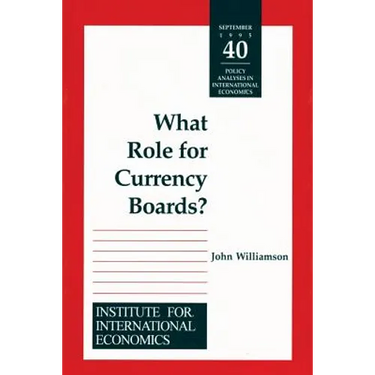

What Role for Currency Boards? - Paperback
 What Role for Currency Boards? - Paperback
$30.31
/
What Role for Currency Boards? - Paperback
$30.31
/

products.product.pickup_availability.unavailable

Your payment information is processed securely. We do not store credit card details nor have access to your credit card information.


by John Williamson (Author)
To help overcome its financial crisis, Russia is being urged to create a currency board, which has met with success in other countries such as Argentina, Estonia, and Hong Kong. This study explains what a currency board is and how it differs from a central bank, and examines the advantages and disadvantages of each type of arrangement. The author concludes that currency boards may be quite attractive to small, open economies and a useful prop in those emerging from a very deep macroeconomic crisis, but that their disadvantages outweigh these attractions in most large countries.
Author Biography
John Williamson, senior fellow (retired), was associated with the Institute from 1981 to 2012. He was project director for the UN High-Level Panel on Financing for Development (the Zedillo Report) in 2001; on leave as chief economist for South Asia at the World Bank during 1996-99; economics professor at Pontifica Universidade Católica do Rio de Janeiro (1978-81), University of Warwick (1970-77), Massachusetts Institute of Technology (1967, 1980), University of York (1963-68), and Princeton University (1962-63); adviser to the International Monetary Fund (1972-74); and economic consultant to the UK Treasury (1968-70).

