
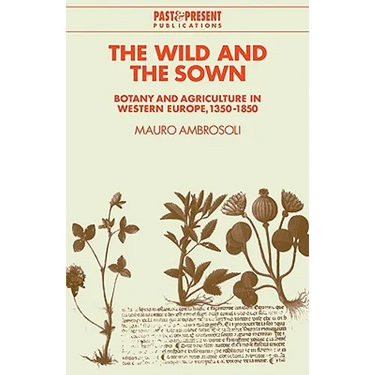

The Wild and the Sown: Botany and Agriculture in Western Europe, 1350 1850 - Paperback
 The Wild and the Sown: Botany and Agriculture in Western Europe, 1350 1850 - Paperback
$114.10
/
The Wild and the Sown: Botany and Agriculture in Western Europe, 1350 1850 - Paperback
$114.10
/

products.product.pickup_availability.unavailable

Your payment information is processed securely. We do not store credit card details nor have access to your credit card information.


by Mauro Ambrosoli (Author)
This book describes the spread of new agricultural practice in the half millennium after 1350, and reconstructs a neglected part of Europe's agricultural past: the introduction of fodder crops, and the continuous reorganization of traditional botanical inputs within a new system of farming. It breaks entirely new ground by showing the distant historical origins of a major transformation in land potential and farm productivity. A vast range of evidence is cited from Italy, France, England and elsewhere to produce in effect an economic, social and cultural history of Europe in which the focus is on the long-distance consequences of the "agricultural revolution".
Back Jacket
This book describes the spread of new agricultural practice between 1350 and 1850, and reconstructs a neglected part of Europe's agricultural past: the introduction of fodder crops, and the continuous reorganisation of traditional botanical inputs within a new system of farming. New agricultural systems, based on convertible husbandry, clovers, turnips and other roots, were introduced to some areas of Europe from the 1550s, and gave new impetus to productivity. This so-called 'agricultural revolution' involved a learning process in which recourse to ancient and medieval botany helped farmers and the more learned landowners to overcome a situation of stalemate in early modern technology. The book breaks entirely new ground by showing the distant historical origins of a major transformation in land potential and farm productivity. A vast range of evidence is cited from Italy, France, England and elsewhere to produce in effect an economic, social and cultural history of European agrarian development in which the focus is on the long-distance consequences of the 'agricultural revolution'.

