
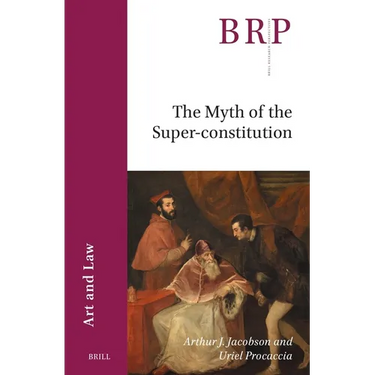

The Myth of the Super-Constitution - Paperback
 The Myth of the Super-Constitution - Paperback
$135.52
/
The Myth of the Super-Constitution - Paperback
$135.52
/

products.product.pickup_availability.unavailable

Your payment information is processed securely. We do not store credit card details nor have access to your credit card information.


by Arthur J. Jacobson (Author), Uriel Procaccia (Author)
Normally, all laws within any given jurisdiction ought to conform to some "higher" legal imperative called a "constitution". In modern times, constitutions are usually embedded in a formal document, and laws that fail to meet this standard are held to be "unconstitutional" and adjudicated null and void. In former times, constitutions often resided in looser terms like "natural law" and rested on extra-legal foundations such as consecrated customs or religious convictions.
However, what happens if the constitution itself is offensive to some deeply ingrained norms within the prevailing culture? Is it possible to override constitutions for failing to meet some elementary standards of decency or moral propriety? In recent memory, critics reviled the Third Reich as a rogue regime in spite of the fact that it meticulously followed its own corrupt policies. Is it possible to maintain the idea that even constitutions must comply with some external standards? Is such a possibility intellectually defensible? Or must we accept the fact that no formal regime is full-proof against the looming threat of human depravity?
Author Biography
Arthur Jacobson is the Max Freund Professor of Litigation and Advocacy Emeritus, Benjamin N. Cardozo School of Law, Yeshiva University. His many publications include the books Weimar: A Jurisprudence of Crisis (2002, University of California Press, with Bernhard Schlink) and Jewish Law and Contemporary Issues (2015, Cambridge University Press, with J. David Bleich).
Uriel Procaccia is the Wachtell, Lipton, Rosen and Katz Professor Emeritus, Faculty of Law, Hebrew University of Jerusalem, and a member of the Federmann Center for the Study of Rationality at the same university. His hundreds of books and articles include Russian Culture, Property Rights and the Market Economy (2007, Cambridge University Press).

