
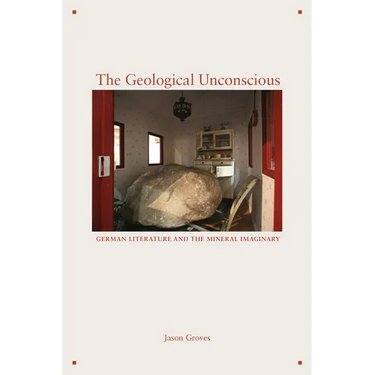

The Geological Unconscious: German Literature and the Mineral Imaginary - Paperback
 The Geological Unconscious: German Literature and the Mineral Imaginary - Paperback
$68.56
/
The Geological Unconscious: German Literature and the Mineral Imaginary - Paperback
$68.56
/

products.product.pickup_availability.unavailable

Your payment information is processed securely. We do not store credit card details nor have access to your credit card information.


by Jason Groves (Author)
Already in the nineteenth century, German-language writers were contending with the challenge of imagining and accounting for a planet whose volatility bore little resemblance to the images of the Earth then in circulation. The Geological Unconscious traces the withdrawal of the lithosphere as a reliable setting, unobtrusive backdrop, and stable point of reference for literature written well before the current climate breakdown.
Through a series of careful readings of romantic, realist, and modernist works by Tieck, Goethe, Stifter, Benjamin, and Brecht, Groves elaborates a geological unconscious--unthought and sometimes actively repressed geological knowledge--in European literature and environmental thought. This inhuman horizon of reading and interpretation offers a new literary history of the Anthropocene in a period before it was named. These close readings show the entanglement of the human and the lithic in periods well before the geological turn of contemporary cultural studies. In those depictions of human-mineral encounters, the minerality of the human and the minerality of the imagination become apparent. In registering libidinal investments in the lithosphere that extend beyond Carboniferous deposits and beyond any carbon imaginary, The Geological Unconscious points toward alternative relations with, and less destructive mobilizations of, the geologic.Back Jacket
"The Geological Unconscious offers subtle close readings of several canonical texts that receive provocative illumination from ecocriticism. The book's focus on the instability of ground is insightfully paired with a consideration of how already in the nineteenth century literary style and narrative register geological time and planetary wounding."--Catriona MacLeod, University of Chicago
"An impressive and accomplished study that delves deep into the layers of German mineralogical imagination from Goethe to Benjamin. Stones may not be able to speak, but they have found their spokesman. A pleasure to read."--Geoffrey Winthrop-Young, University of British Columbia Already in the nineteenth century, German-language writers were contending with the challenge of imagining and accounting for a planet whose volatility bore little resemblance to the images of the Earth then in circulation. The Geological Unconscious traces the withdrawal of the lithosphere as a reliable setting, unobtrusive backdrop, and stable point of reference for literature written well before the current climate breakdown. Through a series of careful readings of romantic, realist, and modernist works by Tieck, Goethe, Stifter, Benjamin, and Brecht, Groves elaborates a geological unconscious--unthought and sometimes actively repressed geological knowledge--in European literature and environmental thought. This inhuman horizon of reading and interpretation offers a new literary history of the Anthropocene in a period before it was named. These close readings show the entanglement of the human and the lithic in periods well before the geological turn of contemporary cultural studies. In those depictions of human-mineral encounters, the minerality of the human and the minerality of the imagination become apparent. In registering libidinal investments in the lithosphere that extend beyond Carboniferous deposits and beyond any carbon imaginary, The Geological Unconscious points toward alternative relations with, and less destructive mobilizations of, the geologic. Jason Groves is Assistant Professor of Germanics at the University of Washington. He is cotranslator of Werner Hamacher's Minima Philologica.Author Biography
Jason Groves is Assistant Professor of Germanics at the University of Washington. He is cotranslator of Werner Hamacher's Minima Philologica.

