
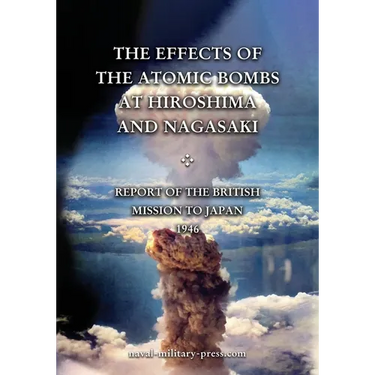

THE EFFECTS OF THE ATOMIC BOMBS AT HIROSHIMA AND NAGASAKI Report of the British Mission to Japan 1946 - Paperback
 THE EFFECTS OF THE ATOMIC BOMBS AT HIROSHIMA AND NAGASAKI Report of the British Mission to Japan 1946 - Paperback
$27.14
/
THE EFFECTS OF THE ATOMIC BOMBS AT HIROSHIMA AND NAGASAKI Report of the British Mission to Japan 1946 - Paperback
$27.14
/

products.product.pickup_availability.unavailable

Your payment information is processed securely. We do not store credit card details nor have access to your credit card information.


by Anon (Author)
On August 6th, 1945, shortly after 8 a.m., an American Super-Fortress flying at 30,000 feet dropped a single atomic bomb over the Japanese mercantile city of Hiroshima. The bomb exploded over the city centre. Three days later, on August 9th, just after 11 a.m., a Super-Fortress flying at the same height, which had found its primary target cloud-obscured, dropped a second atomic bomb over the industrial city of Nagasaki. This bomb exploded over the city's factory area. In Hiroshima more than four square miles of city were destroyed and 80,000 people were killed. In the smaller city of Nagasaki about one and a half square miles were destroyed and nearly 40,000 people were killed. The causes of destruction and of death differed in many points from those which had acted in the conventional raids of the past. It was clear that bombing had changed its character and its scale beyond recognition.
Subjects covered include:
BLAST EFFECTS
DAMAGE TO, COMMERCIAL & INDUSTRIAL BUILDINGS, MACHINES, HOUSES & SHELTERS PUBLIC SERVICES
FLASHBURN
RADlO-ACTIVE EFFECTS
CASUALTIES

