
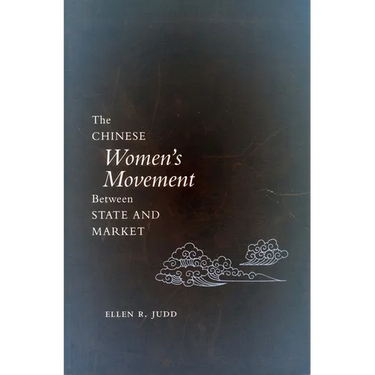

The Chinese Women's Movement Between State and Market - Paperback
 The Chinese Women's Movement Between State and Market - Paperback
$44.80
/
The Chinese Women's Movement Between State and Market - Paperback
$44.80
/

products.product.pickup_availability.unavailable

Your payment information is processed securely. We do not store credit card details nor have access to your credit card information.


by Ellen R. Judd (Author)
This is the story of how the women's movement in China took advantage of the government's official efforts to position women in the rural economic reforms of the 1980s to achieve a significant and ever-increasing role in China's developing turn toward a market economy, which was not the state's intent.
Front Jacket
When China embarked on its rural economic reforms in the early 1980s, changes for women were not a planned part of its program for economic development, in the countryside or in the nation at large.
In the late 1980s the official arm of the Chinese women's movement, the Women's Federations, began experimenting with a series of strategies designed to position women in the mainstream of the reform-era economy. A distinctive feature of this initiative was its focus on "quality" (suzhi), including literacy, general education, and practical technical training, and extending to a general effort to strengthen women's place in the market. The state's official women's movement had paradoxically become the major champion and architect of rural Chinese women's turn toward the market economy.
This book examines in detail how the women's movement strategy was developed and implemented in one village in the northern Chinese province of Shandong, exploring the multiple meanings of the discourse on quality and the creation of a uniquely Chinese gender-and-development policy. The author explores several dimensions of this strategy: the promotion of education and training, the building of an organizational base for the rural women's movement, and the expansion of women's involvement in market competition. The author broadens the scope of the book by comparing similar strategies pursued in urban women's organizations in Shandong in the 1990s.
Back Jacket
For people looking for contemporary strategies to promote education, literacy and training for women in rural settings in order to improve their involvement in market competition, this book will be a helpful guide. It adds to the literature on gender and development and creates new signposts for the women's movement.--Feminist Academic Press Column
"In this book, Ellen Judd provides a crisply clear, well documented and thorough account of the way in which 'the women's movement' has responded to the new demands of the reform era and the increased salience of the market economy. . . . This is a useful and well researched book, reflecting a long period of reflection. It deserves a far wider readership than simply 'Chinese' anthropologists or sociologists."--Canadian Journal of Sociology Online
Author Biography
Ellen R. Judd is Professor and Head of Anthropology at the University of Manitoba. She is the author of Gender and Power in Rural North China (Stanford, 1994), and the co-editor of Feminists Doing Development: A Practical Critique.

