
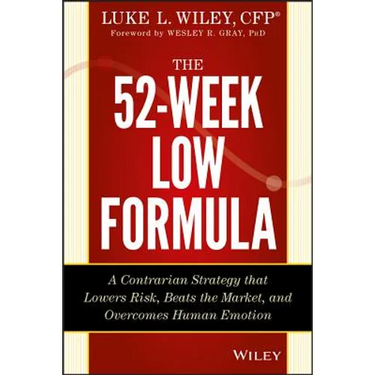

The 52-Week Low Formula - Hardcover
 The 52-Week Low Formula - Hardcover
$41.95
/
The 52-Week Low Formula - Hardcover
$41.95
/

products.product.pickup_availability.unavailable

Your payment information is processed securely. We do not store credit card details nor have access to your credit card information.


by Luke L. Wiley (Author), Wesley R. Gray (Foreword by)
A new but timeless strategy and mindset that should greatly help investors lower downside risk while achieving market outperformance
In The 52-Week Low Formula: A Contrarian Strategy that Lowers Risk, Beats the Market, and Overcomes Human Emotion, wealth manager Luke L. Wiley, CFP examines the principles behind selecting the outstanding companies and great investment opportunities that are being overlooked.
Along the way, Wiley offers a melding of the strategies used by such investment giants as Warren Buffett, Howard Marks, Michael Porter, Seth Klarman, and Pat Dorsey. His proven formula helps investors get the upper hand by identifying solid companies that are poised for growth but have fallen out of the spotlight.
- Shows you how to investigate companies and identify opportunities
- Includes detailed discussions of competitive advantage, purchase value, return on invested capital, and debt levels
- Presents several case studies to examine companies that have overcome obstacles by trading around their 52-week lows
The 52-Week Low Formula is a must-read for investors and financial advisors who want to break through conventional strategies and avoid common mistakes.
Front Jacket
Successful investing is based on simple principles. Buy low, sell high. Make good decisions based upon good information. Try to eliminate noise and emotional confusion. Mitigate risk.
Yet, too often, investors fall into familiar traps that lead to suboptimal results. Herding, emotional investing, following the trends instead of the data, taking unnecessary risks-- all of these have a common root cause: The lack of a disciplined system for determining investment opportunities.
In The 52-Week Low Formula: A Contrarian Strategy that Lowers Risk, Beats the Market, and Overcomes Human Emotion, Luke L. Wiley, CFP(R), examines the formula filters behind selecting the outstanding companies and great investment opportunities that are being overlooked, resulting in bigger gains, reduced risk, and faster recovery following economic downturns.
Using his own experiences, deep research, and a healthy degree of skepticism as a guide, Wiley describes what he looks for in a company, what requirements must be met, and how those criteria came into existence. He also presents several case studies to examine companies that were trading around their 52-Week Lows, overcame obstacles, and provided solid investment returns. His book is based on the idea that five simple yet critical filters can lead to mitigating downside risk while achieving market outperformance.
The companies that positively make it through these filters, and that are found to be in the midst of a skid, are the ones that are ripe for investment yet continue to be overlooked and unloved by Main Street to Wall Street.
The 52-Week Low Formula is a must read for investors, money managers, and financial advisors who want to break through suboptimal conventional strategies and avoid common mistakes. It presents a new but timeless strategy and mindset that should greatly help investors lower risk while outperforming the market.
Back Jacket
Successful investing is based on simple principles. Buy low, sell high. Make good decisions based upon good information. Try to eliminate noise and emotional confusion. Mitigate risk.
Yet, too often, investors fall into familiar traps that lead to suboptimal results. Herding, emotional investing, following the trends instead of the data, taking unnecessary risks--all of these have a common root cause: The lack of a disciplined system for determining investment opportunities.
In The 52-Week Low Formula: A Contrarian Strategy that Lowers Risk, Beats the Market, and Overcomes Human Emotion, Luke L. Wiley, CFP(R), examines the formula filters behind selecting the outstanding companies and great investment opportunities that are being overlooked, resulting in bigger gains, reduced risk, and faster recovery following economic downturns.
Using his own experiences, deep research, and a healthy degree of skepticism as a guide, Wiley describes what he looks for in a company, what requirements must be met, and how those criteria came into existence. He also presents several case studies to examine companies that were trading around their 52-Week Lows, overcame obstacles, and provided solid investment returns. His book is based on the idea that five simple yet critical filters can lead to mitigating downside risk while achieving market outperformance.
The companies that positively make it through these filters, and that are found to be in the midst of a skid, are the ones that are ripe for investment yet continue to be overlooked and unloved by Main Street to Wall Street.
The 52-Week Low Formula is a must read for investors, money managers, and financial advisors who want to break through suboptimal conventional strategies and avoid common mistakes. It presents a new but timeless strategy and mindset that should greatly help investors lower risk while outperforming the market.
Author Biography
LUKE L. WILEY, CFP(R), CRPC, is the Senior Vice President of Wiley Wealth Management at UBS Financial Services in Cincinnati, Ohio. In 2012, he was among the top ten of the 7,000 UBS Financial Advisors in client retention and acquisition and has been called upon to provide strategic guidance for other wealth managers, financial planners, and investment managers by UBS management. His investment strategy and approach to life was defined by 17th century German mathematician Carl Gustav Jacob Jacobi who once wrote, "Invert, always invert." By solving for the opposite of your intended result, non-traditional paths to success reveal themselves. The idea of finding attractive investment opportunities within the 52-Week Low lists came about from Wiley reading a book that sells used for about $1,400 written by Seth Klarman, Margin of Safety-Risk-Averse Value Investing Strategies for the Thoughtful Investor.

