
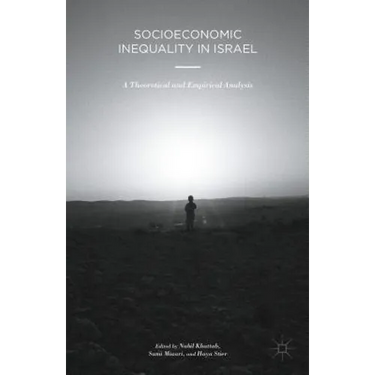

Socioeconomic Inequality in Israel: A Theoretical and Empirical Analysis - Hardcover
 Socioeconomic Inequality in Israel: A Theoretical and Empirical Analysis - Hardcover
$96.08
/
Socioeconomic Inequality in Israel: A Theoretical and Empirical Analysis - Hardcover
$96.08
/

products.product.pickup_availability.unavailable

Your payment information is processed securely. We do not store credit card details nor have access to your credit card information.


by Nabil Khattab (Editor), Sami Miaari (Editor), Haya Stier (Editor)
This volume addresses different aspects and areas of inequality in Israel, a country characterized by high levels of economic inequality, poverty, and social diversity. The book expands on the mechanisms that produce and maintain inequality, and the role of state policies in influencing those mechanisms.
Back Jacket
This book uses different methodologies to explore inequality in a number of areas of Israeli society, focusing on Israel's diverse populations and communities. Israel is an interesting case among industrialized countries as the level of inequality is high across a number of measures. The country is extremely divided along ethnic, national, religious, and political lines, producing unique conditions within which the effects of factors such as gender, class, region, age, and education are highly contextualized. Income inequality in Israel is among the highest in the Western world; the poverty rate and income gap between classes are similarly high. The chapters in this volume address different aspects and areas of such inequalities in Israel. Conclusions drawn here expand our knowledge and understanding of the various mechanisms through which inequality is produced and maintained in Israel as well as the role that state policies play in minimizing or increasing the impact of these mechanisms.
Author Biography
Nabil Khattab is Senior Lecturer in Sociology at the Hebrew University of Jerusalem, Israel, and Honorary Research Fellow at the University of Bristol, UK. His latest publications include the co-edited volume Palestinians in the Israeli Labor Market: A Multi-disciplinary Approach and numerous articles in peer-reviewed journals such as Sociology, The Social Science Journal, and the British Educational Research Journal.
Sami Miaari is Lecturer at the Department of Labor Studies, Tel-Aviv University, Israel, and Research Fellow at the Israeli Democracy Institute. His research focuses on labor economics, economic causes, and consequences of conflict, including the economic costs of political instability and the relationship between economic shocks and conflict. His work on these issues has appeared in mainstream journals of economics such as the Journal of Public Economics, Journal of Population Economics, and Journal of Conflict Resolution.
Haya Stier is Professor of Sociology and Labor Studies at Tel-Aviv University, Israel. She has served as Chair of the Labor Studies Department, President of the Research Committee on Social Stratification, and the editor of Israeli Sociology. Her works on work-family issuesand inequality have appeared in leading sociological journals.

