
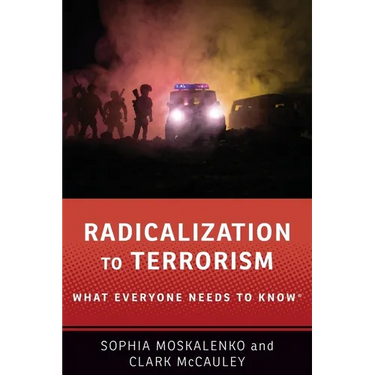

Radicalization to Terrorism: What Everyone Needs to Know(r) - Paperback
 Radicalization to Terrorism: What Everyone Needs to Know(r) - Paperback
$26.95
/
Radicalization to Terrorism: What Everyone Needs to Know(r) - Paperback
$26.95
/

products.product.pickup_availability.unavailable

Your payment information is processed securely. We do not store credit card details nor have access to your credit card information.


by Sophia Moskalenko (Author), Clark McCauley (Author)
Terrorism and radicalization came to the forefront of news and politics in the US after the unforgettable attacks of September 11th, 2001. When George W. Bush famously asked "Why do they hate us?," the President echoed the confusion, anger and fear felt by millions of Americans, while also creating a politicized discourse that has come to characterize and obscure discussions of both phenomena in the media.
Since then the American public has lived through a number of domestic attacks and threats, and watched international terrorist attacks from afar on television sets and computer screens. The anxiety and misinformation surrounding terrorism and radicalization are perhaps best detected in questions that have continued to recur in the last decade: "Are terrorists crazy?"; "Is there a profile of individuals likely to become terrorists?"; "Is it possible to prevent radicalization to terrorism?" Fortunately, in the two decades since 9/11, a significant body of research has emerged that can help provide definitive answers. As experts in the psychology of radicalization, Sophia Moskalenko and Clark McCauley propose twelve mechanisms that can move individuals, groups, and mass publics from political indifference to sympathy and support for terrorist violence. Radicalization to Terrorism: What Everyone Needs to Know synthesizes original and existing research to answer the questions raised after each new attack, including those committed by radicalized Americans. It offers a rigorously informed overview of the insight that will enable readers to see beyond the relentless news cycle to understand where terrorism comes from and how best to respond to it.Author Biography
Sophia Moskalenko is a research fellow at the National Consortium for the Study of Terrorism and Responses to Terrorism, where she has worked on projects commissioned by the United States Department of Defense, Department of Homeland Security, and Department of State. Her own research on terrorism and radicalization has been presented in scientific conferences, government briefings, radio broadcasts, and international television newscasts. She teaches psychology at the University of Pennsylvania.
Clark McCauley is Professor Emeritus of Psychology at Bryn Mawr University, where he taught until 2016. He has been a lead investigator for the National Consortium for Study of Terrorism and Responses to Terrorism. His research interests include group dynamics, stereotyping, disgust, and intergroup conflict, especially in relation to genocide and terrorism. He is a member of the editorial boards of Dynamics of Asymmetric Conflict, Terrorism and Political Violence, and Peace and Conflict: The Journal of Peace Psychology. He lives in Lander, Wyoming.
%20-%20Paperback)