
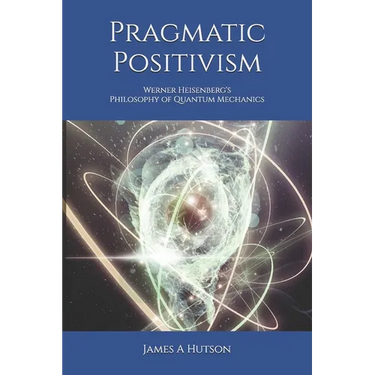

Pragmatic Positivism: Werner Heisenberg's Philosophy of Quantum Mechanics - Paperback
 Pragmatic Positivism: Werner Heisenberg's Philosophy of Quantum Mechanics - Paperback
$27.18
/
Pragmatic Positivism: Werner Heisenberg's Philosophy of Quantum Mechanics - Paperback
$27.18
/

products.product.pickup_availability.unavailable

Your payment information is processed securely. We do not store credit card details nor have access to your credit card information.


by James A. Hutson (Author)
Werner Heisenberg (1901-1976) was one of the great physicists of the early twentieth-century. His contributions to the development of quantum mechanics are paralleled only by the likes of Albert Einstein and Niels Bohr. The philosophical foundations of quantum mechanics have been debated since its creation though. Heisenberg's philosophical approach to his own scientific contributions has been disputed by scholars for decades.
A key to understanding Heisenberg's beliefs with regards to quantum mechanics can be obtained by considering the philosophy of Willard Van Orman Quine (1908-2000). Quine was a professor of philosophy associated with Harvard University and wrote extensively on logic, language, epistemology, empiricism, and metaphysics. While both figures make use of some version of positivism, The intellectual toolkit they both use, modifies it in several ways when applying this to empirical data. Heisenberg and Quine both opt instead for a pragmatic positivism rather than the more well-known version, logical positivism.
The relation between the two is an example of a scientist engaging with philosophy in order to make progress in his chosen field. Quine, as a philosopher, does the inverse. He abstracts from the particular case of how to understand quantum mechanics in a theoretical sense and generalizes the approach to the entirety of science..

