
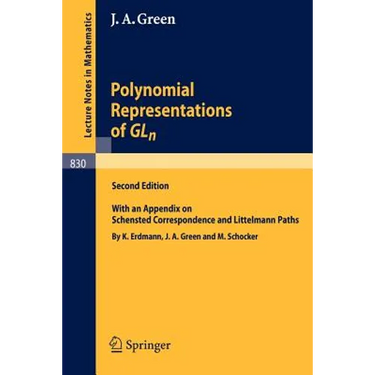

Polynomial Representations of Gl_n: With an Appendix on Schensted Correspondence and Littelmann Paths - Paperback
 Polynomial Representations of Gl_n: With an Appendix on Schensted Correspondence and Littelmann Paths - Paperback
$79.88
/
Polynomial Representations of Gl_n: With an Appendix on Schensted Correspondence and Littelmann Paths - Paperback
$79.88
/

products.product.pickup_availability.unavailable

Your payment information is processed securely. We do not store credit card details nor have access to your credit card information.


by K. Erdmann (Appendix by), James A. Green (Author), James A. Green (Appendix by)
This second edition of "Polynomial representations of GL (K)" consists of n two parts. The ?rst part is a corrected version of the original text, formatted A in LT X, and retaining the original numbering of sections, equations, etc. E The second is an Appendix, which is largely independent of the ?rst part, but whichleadstoanalgebraL(n, r), de?nedbyP.Littelmann, whichisanalogous to the Schur algebra S(n, r). It is hoped that, in the future, there will be a structure theory of L(n, r) rather like that which underlies the construction of Kac-Moody Lie algebras. We use two operators which act on "words". The ?rst of these is due to C. Schensted (1961). The second is due to Littelmann, and goes back to a1938paperbyG.deB.Robinsonontherepresentationsofa?nitesymmetric group.Littelmann'soperatorsformthebasisofhiselegantandpowerful"path model" of the representation theory of classical groups. In our Appendix we use Littelmann's theory only in its simplest case, i.e. for GL . n Essential to my plan was to establish two basic facts connecting the op- ations of Schensted and Littelmann. To these "facts", or rather conjectures, I gave the names Theorem A and Proposition B. Many examples suggested that these conjectures are true, and not particularly deep. But I could not prove either of them.
Back Jacket
The first half of this book contains the text of the first edition of LNM volume 830, Polynomial Representations of GLn. This classic account of matrix representations, the Schur algebra, the modular representations of GLn, and connections with symmetric groups, has been the basis of much research in representation theory.
The second half is an Appendix, and can be read independently of the first. It is an account of the Littelmann path model for the case gln. In this case, Littelmann's 'paths' become 'words', and so the Appendix works with the combinatorics on words. This leads to the repesentation theory of the 'Littelmann algebra', which is a close analogue of the Schur algebra. The treatment is self- contained; in particular complete proofs are given of classical theorems of Schensted and Knuth.

