
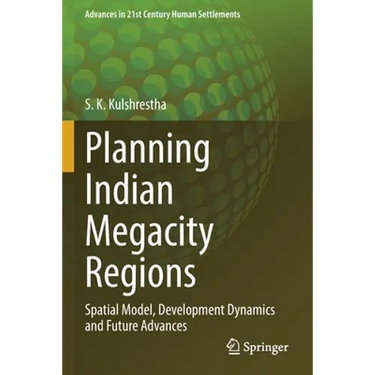

Planning Indian Megacity Regions: Spatial Model, Development Dynamics and Future Advances - Paperback
 Planning Indian Megacity Regions: Spatial Model, Development Dynamics and Future Advances - Paperback
$168.98
/
Planning Indian Megacity Regions: Spatial Model, Development Dynamics and Future Advances - Paperback
$168.98
/

products.product.pickup_availability.unavailable

Your payment information is processed securely. We do not store credit card details nor have access to your credit card information.


by S. K. Kulshrestha (Author)
Chapter 1 Evolution of Large Cities and Megacity Regions
Growth and Spatial Distribution of Large CitiesGlobal Scenario
Growth of Million-plus Cities in IndiaGeographical Distribution of M+ Cities
Distribution of MegacitiesDistribution among States / UTs
Primacy at State-levelCharacteristics of Megacities in India
Merging of Cities and Evolution of new Regional Spatial PatternsUrban Corridors
DMICChennai-Bengaluru Industrial Corridor (CBIC)
Bengaluru-Mumbai Economic Corridor (BMEC)Vizag-Chennai Industrial Corridor (VCIC)
Amritsar-Kolkata Industrial Corridor (AKIC)Defence Corridor
East Coast Economic Corridor (ECEC)Mega-regions
City Regions
City Region: Definition
Metro-city RegionsMegacity Regions
Polycentric RegionsFunctional / Morphological Polycentricity
Chapter 2 Megacity Region Spatial Model
Earlier Attempts
Polarised Activity Centres ModelAdaption of PAC Model for Megacity Region
Approach to ConceptualisationStructure of a Megacity Region
Spatial ConfigurationBasis for Spatial Arrangement
Basic Spatial Unit of the Model: Cluster of VillagesMicro-Region
Sub-RegionMegacity Region
Basic Characteristics of the Megacity Region Spatial ModelSettlement Pattern
Road Hierarchy and Pattern
Advance reservation for other Transit Systems
Flexibility in the Model Application
Application to Coastal Megacity RegionsApplication as Urban Corridors
Application to less than a Million City RegionsApplication to Million-plus City Regions
Cascading of Micro-regionsFlexibility to to Spatial Planners
Testing the Megacity Region Spatial ModelOverall Spatial Configuration
The Radius of Influence of a MegacityTotal Area of the Megacity Region
Regional Spatial Hierarchical Units and their GovernanceMicro-regions
Sub-regionsComposition of Megacity Region Core
Test ResultsApplication of Megacity Region Spatial Model
Application as a Descriptive ToolAppraisal of existing Regional Plans: examples of NCR and MMR
Preparation for applicationRegional Spread
Sub-regionsSettlement Hierarchy
Road Hierarchy and Road PatternApplication as a Prescriptive Tool
Steps for application for planning megacity regionSteps for application for planning at sub-regional / district level
Steps for application for planning at micro-regional / block level
Application of the Spatial Model to Megacity Regions in other Countries
Chapter 3 Dynamics of Megacity Regional Development
Introduction
Need for Preparation of Regional Plan for Delhi
The Mass Migration of 1947-48
Establishing an Institutional Framework for Regional Planning
High Power Board
Constitution of NCR Planning Board
Dynamics of Spatial DevelopmentSpatial Structure
Spatial PatternsHierarchy of Settlements
Settlement PatternLand Utilisation Zones
Land CoverRoad Patterns
Dynamics of Socio-economic DevelopmentPolicy of Containment of Delhi's Population
Policy of Dispersal of Employment-generating Activities from DelhiPolicy of dispersal of Central Government Offices
Back Jacket
This book focuses on spatial planning of megacities that are growing in Asia, Africa, and America. These cities are not be seen in isolation from their respective influence regions. They complement each other. Most of the solutions to the problems of such cities are found in their respective regions, and, on the other hand, the regions derive their strength from their respective megacities. There is a need for promoting integrated spatial planning of megacity regions. The five chapters in this book highlight the spatial planning of such regions.
Author Biography
Dr. S. K. Kulshrestha obtained his Ph. D. from Ahmadu Bello University, Nigeria. He is Urban and Regional Planner and Author with more than 50 years of teaching experience, research, and professional practice in the field of spatial planning. He has also been Senior Consultant (Planning Expert) at Gesellschaft für Internationale Zusammenarbeit (GIZ), Germany.

