
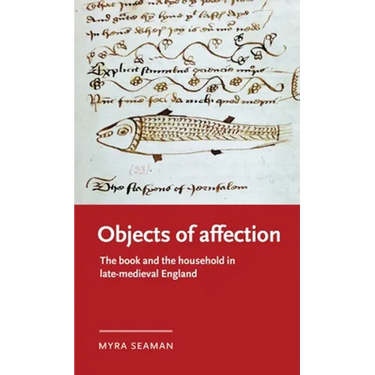

Objects of Affection: The Book and the Household in Late Medieval England - Paperback
 Objects of Affection: The Book and the Household in Late Medieval England - Paperback
$70.18
/
Objects of Affection: The Book and the Household in Late Medieval England - Paperback
$70.18
/

products.product.pickup_availability.unavailable

Your payment information is processed securely. We do not store credit card details nor have access to your credit card information.


by Myra Seaman (Author)
Objects of affection recovers the emotional attraction of the medieval book through an engagement with a fifteenth-century literary collection known as Oxford, Bodleian Library Manuscript Ashmole 61. Exploring how the inhabitants of the book's pages - human and nonhuman, tangible and intangible - collaborate with its readers then and now, this book addresses the manuscript's material appeal in the ways it binds itself to different cultural, historical and material environments. In doing so it traces the affective literacy training that the manuscript provided its late-medieval English household, whose diverse inhabitants are incorporated into the ecology of the book itself as it fashions spiritually generous and socially mindful household members.
Back Jacket
Objects of affection reveals the affective agency of the book by exploring the emotional literacy training that a single codex provided to a late-medieval English household.
Oxford, Bodleian Library Manuscript Ashmole 61 was produced by a scribe in Leicestershire sometime between 1475 and 1510. It includes forty-one verse texts that encourage particular performances of late-medieval Christian citizenship. Objects of affection examines how the body of the manuscript, including images of fish and flowers scattered like graffiti throughout, contributes to the reader's full experience. It shows that diverse inhabitants of the household produce the ecology of the book as they are incorporated into it: in the material world they generate and that guides their living, in the social and spiritual desires that shape their influences in that world, and so on. Ultimately, Ashmole 61 affirms not only the physical but the moral agency of nonhumans, as they fashion spiritually generous and socially mindful human household members. Objects of affection utilizes and contributes to three clusters of approaches: manuscript studies and history of the book; new materialisms, object studies, and critical animal studies; and the history of emotions. This methodological assemblage will be of interest to interdisciplinary audiences, from academic libraries and individual scholars to graduates and undergraduates in courses focusing on MS Ashmole 61 and other late-medieval manuscripts.Author Biography
Myra Seaman is Professor of English at the College of Charleston

