
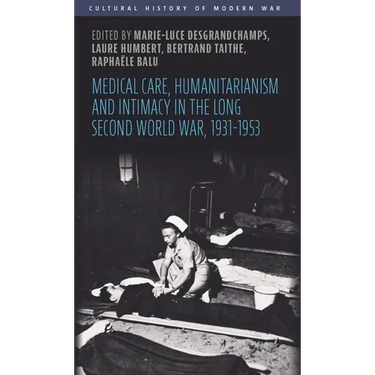

Medical Care, Humanitarianism and Intimacy in the Long Second World War, 1931-1953 - Hardcover
 Medical Care, Humanitarianism and Intimacy in the Long Second World War, 1931-1953 - Hardcover
$70.18
/
Medical Care, Humanitarianism and Intimacy in the Long Second World War, 1931-1953 - Hardcover
$70.18
/

products.product.pickup_availability.unavailable

Your payment information is processed securely. We do not store credit card details nor have access to your credit card information.


by Marie-Luce Desgrandchamps (Editor), Laure Humbert (Editor), Bertrand Taithe (Editor)
This book explores underexamined sites of interactions and encounters between humanitarians and medical workers during the long Second World War (1931-1953).It traces circulations of humanitarian actors, knowledge, and practices across the world from a conflict to another. In doing so, it demonstrates that the conflict brought about unlikely aid coalitions and intimate networks of aid, and led to a transformation of the relationships between some European organisations and colonial 'peripheries', leading to the emergence of new activities and actors. This book also interrogates the traditional dichotomy between civilian and military cultures of rehabilitation, and readdresses the role of the United States and its rise as a 'humanitarian superpower'.
Back Jacket
This book offers fresh perspectives on the history of humanitarianism and medical care during the long Second World War (1931-1953). Adopting a broad definition of humanitarianism, it addresses new themes, such as intimacy and craft therapy, and moves across scales of analysis, from the global to the local.
The book takes the war in China in 1931 as a starting point, which led to the progressive dislocation of the League of Nations. It ends with the termination of the Korean War in 1953, which represented the end of the first United Coalition and United Nations Peace enforcement operation. It contributes to the development of a theoretically informed understanding of the concept of intimacy, placing at the centre of historical attention the 'experiences' of the war for caregivers and receivers of humanitarian aid.
This volume makes an original intervention by challenging the Eurocentric chronology of the Second World War and tracing circulations of humanitarian actors, knowledge, and practices across the world from a conflict to another. In doing so, it reassesses the links between imperial and national politics and sheds new lights onto the use of humanitarianism as a diplomatic tool and instrument of 'soft power'.
Author Biography
Marie Luce Desgrandchamps, Lecturer, University of Geneva, Senior Researcher, University of Fribourg
Laure Humbert, Senior Lecturer, University of Manchester
Bertrand Taithe, Professor, University of Manchester
Raphaële Balu, Editorial Manager, Sorbonne University

