
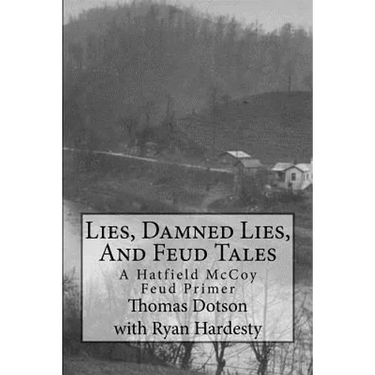

Lies, Damned Lies, And Feud Tales: The Collected Short Works - Paperback
 Lies, Damned Lies, And Feud Tales: The Collected Short Works - Paperback
$27.18
/
Lies, Damned Lies, And Feud Tales: The Collected Short Works - Paperback
$27.18
/

products.product.pickup_availability.unavailable

Your payment information is processed securely. We do not store credit card details nor have access to your credit card information.


by Ryan Hardesty (Author), Thomas Dotson (Author)
The Hatfield McCoy Feud was not just a conflict between two mountain families. It was, perhaps even more significantly, a series of overlapping, interlayered conflicts. While feud lore and much of what has passed for feud history focuses on the conflicts between the family of Anse Hatfield and Randolph McCoy, few writers have properly positioned these events as part of a broader struggle between and among all of the local residents, whether they realized it or not, and more powerful economic and political actors who attempted, quite successfully, to amplify and manipulate local conflicts as a means of advancing their own interests. These outside interests, which reached all the way to the door of the governor of Kentucky, had two distinct advantages over the local people. They had control of the press and control of the law. The feud as we know it grew from a complex interaction of various speakers, journalists, lawyers and lawmen, witnesses in court cases, each validating one another's version of events. This book is a great collection of writing about the Hatfield McCoy Feud by my friend Thomas Dotson. I added intros to all of the pieces to provide crucial context for readers who may not be as familiar with the history of the place, its people, and the social, economic, and political forces that drove these events. Everyone knows something about the Hatfield McCoy Feud, but almost everything that people think they know is wrong! Not just a little wrong, either. The feud as it is currently understood was, we argue, a fiction created by powerful men whose aim was to control hundreds of thousands of valuable acres of Pike and Mingo County real estate. This book is important, in my opinion, not just because it rewrites much of what has previously passed for history when it come to the Hatfield McCoy Feud, but also because it begins to chip away at what has passed for the history of the Appalachian people. The land grab that began as early as 1875 with the Bruen Lands Wars in West Virginia resulted in forced transfer of millions of acres of prime land and minerals from local farmers to outside industrialists, and the transformation of a thousands of independent subsistence farming families into a new landless class of impoverished mountaineers. The events of the Hatfield McCoy Feud lie at ground zero of that theft of wealth, and we are still experiencing the repercussions of that theft. If you want to understand how the people of Central Appalachia became poor, this book is an excellent place to start.
Author Biography
Thomas Dotson was born (at home) on Blackberry Creek, in Pike County, Kentucky, in 1940. He was Belfry High School's first National Merit scholar in 1958, and earned a Masters' degree in Labor Movements and Labor History from Cornell. Leaving Cornell in 1969, he became Director of Education for the United Rubber Workers International Union, in Akron, Ohio. In 1974, he returned to his mountain home area, and started a business, selling mining equipment to local coal mines. In 1980, he bought a small wheel manufacturing company in Saltville, Virginia. He expanded the business by buying the mining and construction wheel business from Goodyear Tire. In 1993, he sold his business to Titan International and devoted his time to real estate, an antique auction business, and researching the history of Southern Appalachia. Mr. Dotson's mother was a McCoy, and he is descended from the Hatfields on both sides. His maternal grandfather, Phillip McCoy, was the son of Asa McCoy and Nancy Hatfield. His paternal grandmother was Mary Hatfield Dotson. He was always a "History nut," who became interested in the story of the Hatfield and McCoy feud after seeing the movie, "Roseanna McCoy" in 1952. From 1952 until 1955, he delivered newspapers to more than a dozen people who remembered the 1880's. From those eyewitnesses, he gleaned a trove of first-hand information from people who had no dog in the fight. Since then, he has spent over two thousand hours in the courthouses and archives of Kentucky, West Virginia and Virginia, digging for jewels of real history that are NOT in the "Feud books."

