
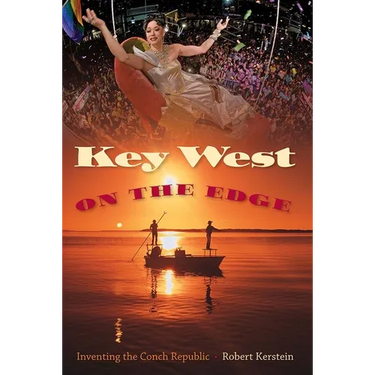

Key West on the Edge: Inventing the Conch Republic - Paperback
 Key West on the Edge: Inventing the Conch Republic - Paperback
$37.24
/
Key West on the Edge: Inventing the Conch Republic - Paperback
$37.24
/

products.product.pickup_availability.unavailable

Your payment information is processed securely. We do not store credit card details nor have access to your credit card information.


by Robert Kerstein (Author)
How the unique island city came to be a major tourist destination
Florida Historical Society Charlton Tebeau Book Award
Key West lies at the southernmost point of the continental United States,
ninety miles from Cuba, at Mile Marker 0 on famed U.S. Highway 1. Famous for
six-toed cats in the Hemingway House, Sloppy Joe's and Captain Tony's, Jimmy
Buffett songs, body paint parade "costumes," and a brief secession
from the Union after which the Conch Republic asked for $1 billion in foreign
aid, Key West also lies at the metaphorical edge of our sensibilities.
How
this unlikely city came to be a tourist mecca is the subject of Robert
Kerstein's intrepid new history. Sited on an island only four miles long and
two miles wide, Key West has been fishing village, salvage yard, U.S. Navy
base, cigar factory, hippie haven, gay enclave, cruise ship port-of-call, and
more. Duval Street, which stretches the length of one of the most unusual
cities in America, is today lined with brand-name shops that can be found in
any major shopping mall in America.
Leaving
no stone unturned, Kerstein reveals how Key West has changed dramatically over
the years while holding on to the uniqueness that continues to attract tourists
and new residents to the island.
Front Jacket
Key West lies at the southernmost point of the continental United States, ninety miles from Cuba, at milemarker zero on the famed highway U.S. 1. Famous for six-toed cats in the Hemingway House, Sloppy Joe's and Captain Tony's, Jimmy Buffett songs, body paint "costumes" during Fantasy Fest, and a brief secession from the Union after which the Conch Republic asked for $1 billion in foreign aid, Key West also lies at the metaphorical edge of our sensibilities.
How this unlikely city came to be a tourist mecca is the subject of Robert Kerstein's intrepid new history of Key West. Sited on an island only four miles long and two miles wide, Key West is neither Florida nor Cuba, neither American nor Caribbean.
Key West in its time has been many things to many different people. It was once the largest city in Florida. It has been one of the wealthiest cities, per capita, in the country; it has also been among the poorest. In the 1980s, it elected the first openly gay mayor in the United States, and later a mayor who, according to the Washington Post, had been a "gambler, gunrunner, saloonkeeper, fishing boat captain, ladies' man, and peerless raconteur." But where Key West is going is hardly clear.
Kerstein examines the reasons for the increase of both short-term tourism and seasonal residents and the consequences of these changes for the community on an island where the demand for real estate quickly escalated above the means of year-round residents and service workers. He contextualizes this movement within a discussion of the character of Key West before it became and as it transitioned into a tourist town.
Key West today is a community constantly being reinvented as it seeks to find a balance between unique and generic, even as it teeters on the edge of losing itself.
Back Jacket
Key West is an island steeped in lore, from Hemingway to Fantasy Fest, but behind the façade of Margaritaville lie buried tensions and conflicts in need of examination. Kerstein provides a much-needed dose of reality in the form of a masterfully researched study of the island's tourism industry, from the shadowy power brokers who pull the strings to the underpaid workers who serve the drinks. From seedy bars to trendy discos, Kerstein has managed to capture the improbable mixture of this strange island, while offering a cautionary tale of tourism run amok.--Robert Lee Irby, author of 7,000 Clams
"An exemplary study and a cautionary tale that should be read by everyone interested in the suicidal course of a society driven by an irrational and self-destructive compulsion to erase differences in the pursuit of the almighty dollar."--Brewster Chamberlin, author of Mario Sanchez: Once Upon a Way of Life "Refreshingly accurate account of how Key West invented the Conch Republic tourist economy from the ruins of the closed military complex. Highly recommended."--Tom Hambright, Monroe County Historian "For anyone who has visited Key West or hopes to do so one day, Bob Kerstein provides a splendid history of the larger-than-life people and powerful social forces that shaped this unique American city into what it is today. He chronicles the decades-long struggle and mixed success of Key West's efforts to avoid the homogenization that seems inevitably to accompany large-scale tourism."--Scott Keeter, Pew Research Center "Bob Kerstein's urban history of the 'Conch Republic' charts the evolution of Key West's quirky, nonconformist charm but also teases out long-running conflicts between its embrace of tourism and defense of authenticity. Alongside fascinating chronicles of the characters and capers that have made this city unique, Key West on the Edge presents a sobering consideration of the ways larger economic forces create tensions between the global and local, modernity and heritage, the power of the market and the power of place."--Rosemary Jann, George Mason UniversityAuthor Biography
Robert Kerstein is professor of government at the University of Tampa and the author of Politics and Growth in Twentieth-Century Tampa.

