
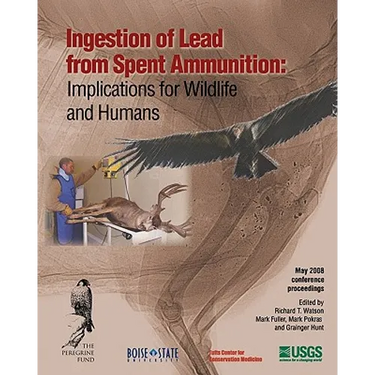

Ingestion of Lead from Spent Ammunition: : Implications for Wildlife and Humans - Paperback
 Ingestion of Lead from Spent Ammunition: : Implications for Wildlife and Humans - Paperback
$40.75
/
Ingestion of Lead from Spent Ammunition: : Implications for Wildlife and Humans - Paperback
$40.75
/

products.product.pickup_availability.unavailable

Your payment information is processed securely. We do not store credit card details nor have access to your credit card information.


by Mark Fuller (Author), Mark Pokras (Author), Grainger Hunt (Author)
Proceedings of the Conference Ingestion of Spent Lead Ammunition: Implications for Wildlife and Humans. 12-15 May 2008, Boise State University, Idaho, United States of America Scientific evidence of the effects of lead on human health has brought forth large scale restrictions on its use, including the prohibition of lead in gasoline and paint. Responses on behalf of wildlife have been less forthcoming, but Bald Eagle consumption of contaminated ducks and geese contributed to the 1991 ban on lead shot for waterfowl hunting in the United States. Lead ammunition is still used in the US for purposes other than waterfowl harvest, and the extent to which lead is secondarily ingested by wildlife and humans has been the subject of recent investigations. An important step in understanding this problem is gathering relevant knowledge and scientific progress on these topics.
Author Biography
Richard Watson, Ph.D. is Vice President and International Programs Director of The Peregrine Fund, an international raptor conservation organization working to restore the California Condor in Arizona and Utah. Grainger Hunt, Ph.D. is a Senior Research Biologist for The Peregrine Fund. Mark Fuller, Ph.D. is a research biologist for the USGS, Forest and Rangeland Ecosystem Science Center, Snake River Field Station, and Director of the Raptor Research Center at Boise State University. Mark Pokras, DVM is Professor and Head of the Tuft's School of Veterinary Medicine's Wildlife Clinic. The Peregrine Fund works worldwide to conserve wild populations of birds of prey. Conserving raptors provides important protection for entire ecosystems, their structure and function, and their biodiversity. We are a non-political, solution-oriented, hands-on, science-based organization. Goals are achieved by restoring and maintaining viable populations of species in jeopardy; studying little-known species; conserving habitat; educating students; developing local capacity for science and conservation in developing countries; and providing factual information to the public.

