
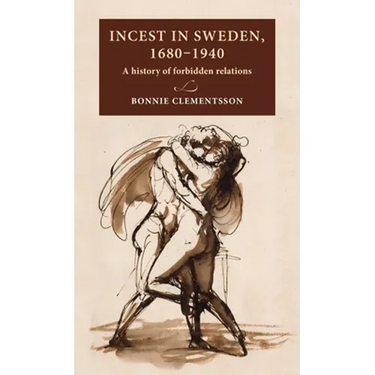


Incest in Sweden, 1680-1940: A History of Forbidden Relations - Hardcover
 Incest in Sweden, 1680-1940: A History of Forbidden Relations - Hardcover
$70.18
/
Incest in Sweden, 1680-1940: A History of Forbidden Relations - Hardcover
$70.18
/

products.product.pickup_availability.unavailable

Your payment information is processed securely. We do not store credit card details nor have access to your credit card information.


by Bonnie Clementsson (Author)
In early modern Sweden, if a man and his deceased wife's sister were found guilty of engaging in sexual intercourse they would be sentenced to death by beheading. Today the same relationship is not even illegal. Covering the period 1680-1940, this book analyses both incest crimes and applications for dispensation to marry, revealing the norms underpinning Swedish society's shifting attitudes to incestuous relations and comparing them with developments in other European countries. It demonstrates that, even though the debate on incest has been dominated by religious, moral and - in due course - medical notions, the values that actually determined the outcome of incest cases were frequently of quite a different character.
An electronic edition of this book is freely available under a Creative Commons (CC BY-NC-ND) licence.Back Jacket
Three hundred years ago in Sweden, if a man and his late wife's sister had sex they ran the risk of being executed. The relationship was defined as an incestuous one, and reprieves were rare. Today, Swedish legislation is among the most liberal in the world. How can such a radical change be accounted for?
The earliest prohibitions against incest came from the Bible, which is why biological kinship and kinship based on marriage were held to be equivalent. Consequently, incest prohibitions around 1700 covered many more relationship categories than exist today. Right up to the late nineteenth century, most incest crimes corresponded to voluntary unions between two adults who were not related by blood. Analysing both incest crimes and applications for dispensation to marry from 1680 to 1940, this book reveals the norms underpinning Swedish society's shifting attitudes to incestuous relations, while considering developments in relation to other European countries. Making a remarkable contribution to social and legal history, Incest in Sweden reveals that, while the debate on incest has historically been dominated by religious, moral and - in due course - medical notions, the values that actually determined the outcome of incest cases were frequently of a quite different character.Author Biography
Bonnie Clementsson is a researcher at Lund University

