
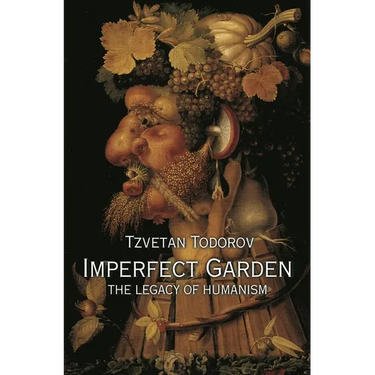

Imperfect Garden: The Legacy of Humanism - Paperback
 Imperfect Garden: The Legacy of Humanism - Paperback
$60.01
/
Imperfect Garden: The Legacy of Humanism - Paperback
$60.01
/

products.product.pickup_availability.unavailable

Your payment information is processed securely. We do not store credit card details nor have access to your credit card information.


by Tzvetan Todorov (Author)
Available in English for the first time, Imperfect Garden is both an approachable intellectual history and a bracing treatise on how we should understand and experience our lives. In it, one of France's most prominent intellectuals explores the foundations, limits, and possibilities of humanist thinking. Through his critical but sympathetic excavation of humanism, Tzvetan Todorov seeks an answer to modernity's fundamental challenge: how to maintain our hard-won liberty without paying too dearly in social ties, common values, and a coherent and responsible sense of self.
Todorov reads afresh the works of major humanists--primarily Montaigne, Rousseau, and Constant, but also Descartes, Montesquieu, and Toqueville. Each chapter considers humanism's approach to one major theme of human existence: liberty, social life, love, self, morality, and expression. Discussing humanism in dialogue with other systems, Todorov finds a response to the predicament of modernity that is far more instructive than any offered by conservatism, scientific determinism, existential individualism, or humanism's other contemporary competitors. Humanism suggests that we are members of an intelligent and sociable species who can act according to our will while connecting the well-being of other members with our own. It is through this understanding of free will, Todorov argues, that we can use humanism to rescue universality and reconcile human liberty with solidarity and personal integrity. Placing the history of ideas at the service of a quest for moral and political wisdom, Todorov's compelling and no doubt controversial rethinking of humanist ideas testifies to the enduring capacity of those ideas to meditate on--and, if we are fortunate, cultivate--the imperfect garden in which we live.Back Jacket
"Tzvetan Todorov's timely book centers on examinations of French thinkers of the sixteenth through nineteenth centuries--Montaigne, Montesquieu, Rousseau, and Constant--but its importance extends well beyond these canny analyses and the particular culture they probe. Imperfect Garden is a moving defense of humanism, an eloquent articulation of its central values of freedom, responsibility, and decency. There is nothing facile about this defense: Todorov enables us to see the fragility, fault lines, and complexity of secular, democratic thought. But by the close of this richly thoughtful study, the whole project of modernity has been clarified and powerfully reaffirmed."--Stephen Greenblatt
"Imperfect Garden is a splendid defense of moderate humanism. Tzvetan Todorov carefully reads older French thinkers--Montaigne, Descartes, Montesquieu, and Rousseau--to find a solution to modernity's predicaments. While rejecting twentieth-century overconfidence in the human ability to invent its future (an overconfidence that has led to catastrophe), Todorov remains a strong defender of human autonomy, of respect for the Other, and of the universality of human values."--Thomas Pavel
Author Biography
Tzvetan Todorov is Research Director of the Centre National de la Recherche Scientifique in Paris and the author of many books, including The Conquest of America, On Human Diversity, The Morals of History, Facing the Extreme, and The Fragility of Goodness (Princeton). He writes regularly for the New Republic, Salmagundi, and other publications.

