
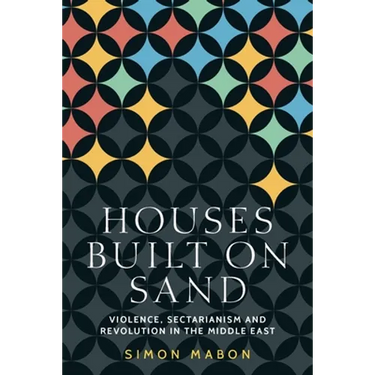

Houses Built on Sand: Violence, Sectarianism and Revolution in the Middle East - Paperback
 Houses Built on Sand: Violence, Sectarianism and Revolution in the Middle East - Paperback
$71.89
/
Houses Built on Sand: Violence, Sectarianism and Revolution in the Middle East - Paperback
$71.89
/

products.product.pickup_availability.unavailable

Your payment information is processed securely. We do not store credit card details nor have access to your credit card information.


by Simon Mabon (Author)
The events of the Arab Uprisings posed an existential challenge to sovereign power across the Middle East. Whilst popular movements resulted in the toppling of authoritarian rule in Tunisia, Egypt and Yemen, other regimes were able to withstand these pressures. This book questions why some regimes fell whilst others were able to survive.
Drawing on the work of political theorists such as Agamben and Arendt, Mabon explores the ways in which sovereign power is contested, resulting in the fragmentation of political projects across the region. Combining an innovative theoretical approach with interviews with people across the region and beyond, Mabon paints a picture of Middle Eastern politics dominated by elites seeking to maintain power and wealth, seemingly at whatever cost. This, for Mabon, is a consequence of the emergence and development of particular visions of political projects that harness or marginalise identities, communities, ideologies and faiths as mechanisms designed to ensure their survival. This book is essential reading for those interested in understanding why the uprisings took place, their geopolitical consequences, and why they are likely to happen again. An electronic edition of this book is freely available under a Creative Commons (CC BY-NC-ND) licence.Back Jacket
'Eloquent, theoretically rich, and marvellously ambitious. Sweeping in its historical and geographic scope, Mabon's work is acute and urgent in calling our attention to the conditions that sustain violence, exclusion, and conflict in today's Arab world.'
Professor Steven Heydemann, Smith College, USA
Staci Strobl, University of Wisconsin-Platteville, USA 'Situated at the nexus between political theory and Middle East Studies, Houses Built on Sand investigates the claims and mechanisms through which life is regulated in the Middle East. The theme of sovereignty and its relationship to political power is the anchor for this rigorously researched book that breaks new intellectual ground. An important and timely contribution, especially for those interested in a philosophical understanding of the turbulence and protest that continues to rock the Arab-Islamic world.'
Nader Hashemi, University of Denver, USA The events of the Arab Uprisings posed an existential challenge to sovereign power across the Middle East. Whilst popular movements resulted in the toppling of authoritarian rule in Tunisia, Egypt and Yemen, other regimes were able to withstand these pressures. This book questions why some regimes fell whilst others were able to survive. Drawing on the work of political theorists such as Agamben and Arendt, Mabon explores the ways in which sovereign power is contested, resulting in the fragmentation of political projects across the region. Combining an innovative theoretical approach with interviews with people across the region and beyond, Mabon paints a picture of Middle Eastern politics dominated by elites seeking to maintain power and wealth, seemingly at whatever cost. This, for Mabon, is a consequence of the emergence and development of particular visions of political projects that harness or marginalise identities, communities, ideologies and faiths as mechanisms designed to ensure their survival. This book is essential reading for those interested in understanding why the uprisings took place, their geopolitical consequences, and why they are likely to happen again. Line for front cover: 'A creative intellectual tour de force, one rarely encountered in studies of the contemporary Middle East.'
Bassel Salloukh
Author Biography
Simon Mabon is Professor of International Politics at Lancaster University where he directs the Richardson Institute. He is also Director of SEPAD.

