
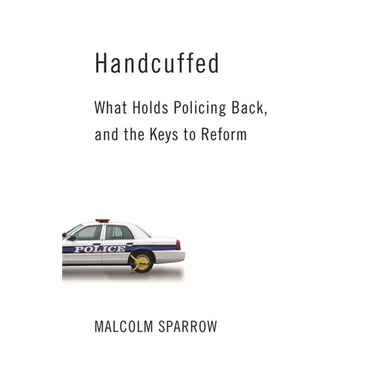

Handcuffed: What Holds Policing Back, and the Keys to Reform - Paperback
 Handcuffed: What Holds Policing Back, and the Keys to Reform - Paperback
$52.29
/
Handcuffed: What Holds Policing Back, and the Keys to Reform - Paperback
$52.29
/

products.product.pickup_availability.unavailable

Your payment information is processed securely. We do not store credit card details nor have access to your credit card information.


by Malcolm K. Sparrow (Author)
The current crisis in policing can be traced to failures of reform.
"Sparrow surely is right to condemn policing directed only at crime rates rather than community satisfaction."
-The New York Times Book Review
In the past two years, America has witnessed incendiary milestones in the poor relations between police and the African-American community: Ferguson, Baltimore, and more recently Baton Rouge, St. Paul, and Dallas.
Malcolm Sparrow, who teaches at Harvard Kennedy School of Government and is a former British police detective, argues that other factors in the development of police theory and practice over the last twenty-five years have also played a major role in contributing to these tragedies and to a great many other cases involving excessive police force and community alienation.
Sparrow shows how the core ideas of community and problem-solving policing have failed to thrive. In many police departments these foundational ideas have been reduced to mere rhetoric. The result is heavy reliance on narrow quantitative metrics, where police define how well they are doing by tallying up traffic stops, or arrests made for petty crimes.
Sparrow's analysis shows what it will take for police departments to escape their narrow focus and perverse metrics and turn back to making public safety and public cooperation their primary goals. Police, according to Sparrow, are in the risk-control business and need to grasp the fundamental nature of that challenge and develop a much more sophisticated understanding of its implications for mission, methods, measurement, partnerships, and analysis.
Front Jacket
The police shooting of an unarmed young black man in the St. Louis suburb of Ferguson, Missouri, in August 2014 sparked riots and the beginning of a national conversation on race and policing. Much of the ensuing discussion has focused on the persistence of racial disparities and the extraordinarily high rate at which American police kill civilians (an average of three per day).
Malcolm Sparrow argues that other factors--critical flaws in the more general development of police theory and practice over the last twenty-five years--have substantially contributed to the current crisis in American policing. Sparrow shows how the reform ideas of community and problem-solving policing, adopted as conventional policing wisdom by the 1990s, have failed to thrive. Many departments give these ideas mere lip-service and still define their success by narrow quantitative metrics--tallying up traffic tickets issued, or arrests made for petty crimes. They focus closely on official but unreliable crime statistics while exercising inadequatecontrol over policing tactics and style. Sparrow says police must escape their narrow focus and perverse metrics and turn back to making public safety and public cooperation their primary goals. Police departments, he argues, are fundamentally in the business of risk-control and harm-reduction, with profound implications for policing strategy, methods, measurements, analysis, and the nature of community interactions.
Author Biography
Malcolm K. Sparrow served ten years with the British Police Service, rising to the rank of Detective Chief Inspector. He has conducted internal affairs investigations, commanded a tactical firearms unit, and has extensive experience with criminal investigation. He is currently professor of the Practice of Public Management at Harvard's John F. Kennedy School of Government and faculty chair of the school's executive program--Strategic Management of Regulatory and Enforcement Agencies. A mathematician by training, he is a patent-holding inventor in the area of automated fingerprint identification systems (AFIS). He holds an MA in mathematics from Cambridge University, an MPA from the Kennedy School, and a PhD in applied mathematics from Kent University at Canterbury.

