
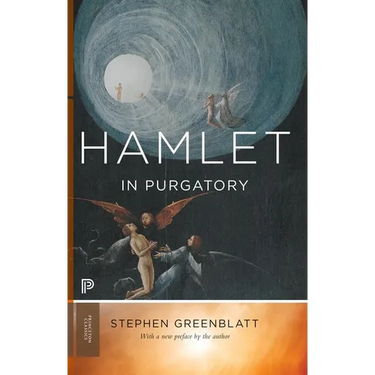

Hamlet in Purgatory: Expanded Edition - Paperback
 Hamlet in Purgatory: Expanded Edition - Paperback
$30.95
/
Hamlet in Purgatory: Expanded Edition - Paperback
$30.95
/

products.product.pickup_availability.unavailable

Your payment information is processed securely. We do not store credit card details nor have access to your credit card information.


by Stephen Greenblatt (Author)
In Hamlet in Purgatory, renowned literary scholar Stephen Greenblatt delves into his longtime fascination with the ghost of Hamlet's father, and his daring and ultimately gratifying journey takes him through surprising intellectual territory. It yields an extraordinary account of the rise and fall of Purgatory as both a belief and a lucrative institution--as well as a capacious new reading of the power of Hamlet.
In the mid-sixteenth century, English authorities abruptly changed the relationship between the living and dead. Declaring that Purgatory was a false "poem," they abolished the institutions and banned the practices that Christians relied on to ease the passage to Heaven for themselves and their dead loved ones. Greenblatt explores the fantastic adventure narratives, ghost stories, pilgrimages, and imagery by which a belief in a grisly "prison house of souls" had been shaped and reinforced in the Middle Ages. He probes the psychological benefits as well as the high costs of this belief and of its demolition. With the doctrine of Purgatory and the elaborate practices that grew up around it, the church had provided a powerful method of negotiating with the dead. The Protestant attack on Purgatory destroyed this method for most people in England, but it did not eradicate the longings and fears that Catholic doctrine had for centuries focused and exploited. In his strikingly original interpretation, Greenblatt argues that the human desires to commune with, assist, and be rid of the dead were transformed by Shakespeare--consummate conjurer that he was--into the substance of several of his plays, above all the weirdly powerful Hamlet. Thus, the space of Purgatory became the stage haunted by literature's most famous ghost. This book constitutes an extraordinary feat that could have been accomplished by only Stephen Greenblatt. It is at once a deeply satisfying reading of medieval religion, an innovative interpretation of the apparitions that trouble Shakespeare's tragic heroes, and an exploration of how a culture can be inhabited by its own spectral leftovers. This expanded Princeton Classics edition includes a new preface by the author.Back Jacket
"Beyond its brilliant illumination of Hamlet, Stephen Greenblatt's book uses historical evidence to probe the nature of human memory--by nature insistent, contradictory, in every sense haunted--as it copes with the stark, yet mysterious reality of death. With a rare combination of learning, imagination and grace Greenblatt has created an exciting work of scholarship, alert to the ways a great work of art can both resemble and transform other modes of discourse and perception."--Robert Pinsky
"Hamlet in Purgatory is a virtuoso exercise in untangling the interwoven threads of feeling and belief in early-seventeenth-century England . . . In this bold and brilliant book, Greenblatt demonstrates utterly compellingly why Hamlet can still hold our spiritual attention today."--Lisa Jardine
"My understanding of the traditions concerning Purgatory, both learned and popular, has been gratifyingly deepened by the rich detail of Greenblatt's study. . . . The nature of the ghost of Hamlet's father is an old scholarly puzzle, but Greenblatt's book raises the discussion to a new level, and does so without dogmatism, rather with a subtle acceptance of the ambiguities inherent not only in the Ghost but in the great play as a whole. The book will be welcomed by all who care about the subject, and for the insights already known to abound in this scholar's work."--Frank Kermode
"Stephen Greenblatt is a famously beguiling writer. That power of enchantment does not fail him here. His skill as a storyteller is constantly on display. But so too is his no less renowned skill as a skeptically demystifying cultural critic. The result is a book whose remarkable energy derives, as does that of Hamlet itself, from the mutually contradictory impulses it so tellingly expresses."--Richard Helgerson, University of California, Santa Barbara
"This book is a brilliant essay on memory. Although it serves as a learned history of the idea of Purgatory and a subtle reading of Hamlet, it is primarily a book about how a culture faces loss, one that is gracefully, even movingly, written and one which reveals, as always, Greenblatt to be an unusually sensitive critic and thinker."--David Scott Kastan, Columbia University
Author Biography
Stephen Greenblatt is the John Cogan University Professor of the Humanities at Harvard University. His many books include "Will in the World: How Shakespeare Became Shakespeare" and "The Swerve: How the World Became Modern," which won a National Book Award and Pulitzer Prize. He is a general editor of "The Norton Shakespeare" and "The Norton Anthology of English Literature"

