
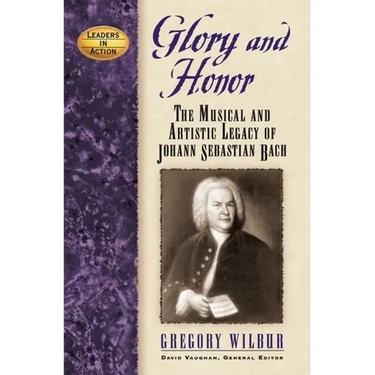

Glory and Honor: The Music and Artistic Legacy of Johann Sebastian Bach - Hardcover
 Glory and Honor: The Music and Artistic Legacy of Johann Sebastian Bach - Hardcover
$38.30
/
Glory and Honor: The Music and Artistic Legacy of Johann Sebastian Bach - Hardcover
$38.30
/

products.product.pickup_availability.unavailable

Your payment information is processed securely. We do not store credit card details nor have access to your credit card information.


by Gregory Wilbur (Author), David Vaughan (Editor)
Johann Sebastian Bach was a musical genius, an intellectual giant and a gracious man. His achievement in the area of music is one of the greatest tours de force in history - on a par with or surpassing that of Shakespeare, Michelangelo, Dante, Rembrandt, or Aquinas. Bach worked at a crucial time in history. He combated the ideas of the Enlightenment with its elevation of human reason as the ultimate authority of everything. His struggles, musically and professionally, are those of a man seeking to maintain a high view of worship, academics, and the grounding of all life on the Word of God. As a man valiant in his convictions, he stood against the trends and fashions of his day and succeeded as a witness of the Gospel to the generations who followed him. While his name conjures many images, musical phrases, and half-remembered stories, the life of this colossal genius provides practical lessons in leadership for both artists and anyone who strives to serve others with excellence and integrity.
Back Jacket
Johann Sebastian Bach was a musical genius and yet a gracious, humble man. A profoundly religious person, he created his musical work as an expression of his devotion to the Lutheran Church. Some have gone so far as to suggest that if there had been no Martin Luther, there would have been no Martin Luther, there would have been no Bach. He learned from Luther's Catechism, read Luther's German bible, and composed music for Luther's church. A gracious man and an intellectual giant, Bach consciously wrote all of his music from a Christian point of view--for the glory of God.
Although he was orphaned at an early age, Bach grew up surrounded by music, and he quickly distinguished himself as an avid learner and apt pupil. The majority of his career was as the cantor of Leipzig--a position that required him to teach school and provide music for the town's churches ever week. During this period he wrote a tremendous amount of music and resisted the ideas of the Enlightenment that sought to undermine church worship. And while his name conjures many images, musical phrases, and half-remembered stories, the life of this colossal genius provides practical lessons in leadership both for artists and for anyone who strives to serve others with excellence and integrity.

