
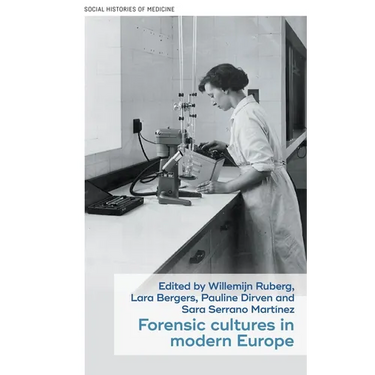

Forensic Cultures in Modern Europe - Hardcover
 Forensic Cultures in Modern Europe - Hardcover
$70.18
/
Forensic Cultures in Modern Europe - Hardcover
$70.18
/

products.product.pickup_availability.unavailable

Your payment information is processed securely. We do not store credit card details nor have access to your credit card information.


by Willemijn Ruberg (Editor), Lara Bergers (Editor), Pauline Dirven (Editor)
This edited volume examines the performance and role of scientific experts in modern European courts of law and police investigations. It discusses cases from criminal, civil and international law to parse the impact of forensic evidence and expertise in different European countries. The contributors show how modern forensic science and technology are inextricably entangled with political ideology, gender norms and changes in the law and legal systems. Discussing fascinating case studies, they highlight how the ideology of authoritarian and liberal regimes has affected the practical enactment of forensic expertise. They also emphasise the influence of images of masculinity and femininity on the performance of experts and on their assessment of evidence, victims and perpetrators. This book is an important contribution to our knowledge of modern European forensic practices.
An electronic edition of this book is freely available under a Creative Commons (CC BY-NC-ND) licence.Back Jacket
This book examines the performance and role of physicians, psychiatrists and other scientific experts in modern European courts of law and police investigations. It interrogates different national legal systems and the value they attach to several types of evidence: bodies, witnesses, material traces and expert testimonies. Analysing forensic cultures, or the way expert knowledge is made at the intersections of science, politics, law, and ideology, it demonstrates how modernity affected the performance of experts in several ways.
Using a range of fascinating case studies, the contributors highlight how the ideology of authoritarian and liberal regimes has affected the practical enactment of forensic expertise. Authoritarian regimes such as Francoist Spain could have a strong impact on the role and impact of forensic experts via law and ideology. New scientific ideas and technology, such as blood tests and DNA, helped developed forensic science, but did not necessarily lead to a straightforward acceptance of expertise in the courtroom. Modern and conservative gender images affected expert performance, judgement and sentencing practices, as illustrated by chapters on rape, crimes of passion and infanticide. Containing engaging chapters about the role of forensic experts in criminal, civil and international law, Forensic cultures in modern Europe shows that their expertise is made in practices that highly vary in different European countries. It makes a significant contribution to the emerging field of the history of forensic science.Author Biography
Lara Bergers is a PhD candidate in History at Utrecht University
Pauline Dirven is a PhD candidate in History at Utrecht University
Willemijn Ruberg is an Associate Professor of Cultural History at Utrecht University
Sara Serrano Martínez is a PhD candidate in History at Utrecht University

