
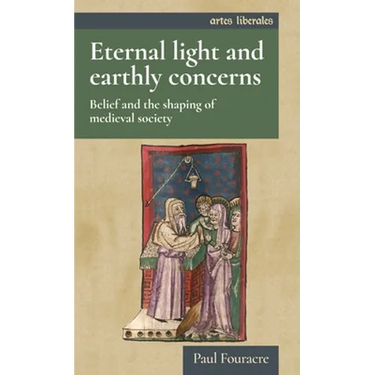

Eternal Light and Earthly Concerns: Belief and the Shaping of Medieval Society - Paperback
 Eternal Light and Earthly Concerns: Belief and the Shaping of Medieval Society - Paperback
$58.21
/
Eternal Light and Earthly Concerns: Belief and the Shaping of Medieval Society - Paperback
$58.21
/

products.product.pickup_availability.unavailable

Your payment information is processed securely. We do not store credit card details nor have access to your credit card information.


by Paul Fouracre (Author)
In early Christianity it was established that every church should have a light burning on the altar at all times. In this unique study, Eternal light and earthly concerns, looks at the material and social consequences of maintaining these 'eternal' lights. It investigates how the cost of lighting was met across western Europe throughout the whole of the Middle Ages, revealing the social organisation that was built up around maintaining the lights in the belief that burning them reduced the time spent in Purgatory. When that belief collapsed in the Reformation the eternal lights were summarily extinguished. The history of the lights thus offers not only a new account of change in medieval Europe, but also a sustained examination of the relationship between materiality and belief.
Back Jacket
In early Christianity it was established that every church should have a light burning on the altar at all times. This unique study investigates the material and social consequences of maintaining such 'eternal lights'.
Never before has the subject been treated as important to the political economy or explored over the whole of the medieval period. The cost of maintaining the lights meant that only the elite could afford to do so, with peasants being organised to provide funds. Later, as society became wealthier, a wider range of people became providers and organised themselves into guilds or confraternities in support of the church and with the particular aim of commemorating their members. Power over the lights, and over individual churches, shifted to these organisations, and when belief in the efficacy of burning lights was challenged in the Reformation, it was such people who were capable of bringing the practice of burning eternal lights to a sudden and sometimes violent end. The study concludes that the practice of keeping a flame on the altar did indeed have important material and cultural consequences. Because it examines the relation between belief and materiality at every turn, the book also serves as a guide to how Western Europe developed from the decline of the Roman Empire to the advent of the Protestant state.Author Biography
Paul Fouracre is Professor Emeritus of Medieval History at the University of Manchester

