
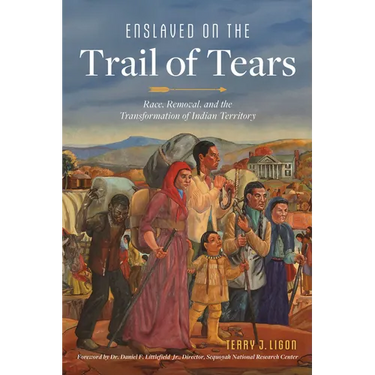

Enslaved on the Trail of Tears: Race, Removal, and the Transformation of Indian Territory - Paperback
 Enslaved on the Trail of Tears: Race, Removal, and the Transformation of Indian Territory - Paperback
$31.99
/
Enslaved on the Trail of Tears: Race, Removal, and the Transformation of Indian Territory - Paperback
$31.99
/

products.product.pickup_availability.unavailable

Your payment information is processed securely. We do not store credit card details nor have access to your credit card information.


by Terry J. Ligon (Author), Daniel F. Littlefield (Foreword by)
A Harrowing Heritage of Resilience
Beginning in the 1820s, Indian removal saw scores of families of African descent forced west alongside the so-called Five Civilized Tribes. The Choctaw, Chickasaw, Cherokee, Muscogee (Creek), and Seminole Nations all brought their own slaves on the arduous, obligatory journey. These tribes demonstrated shared patterns--including Native women enslavers--as well as important distinctions. Seminole records more frequently preserved the names of their enslaved, reflecting resistance to removal and the central role of Black Seminoles. But enslaved people were present at every stage of removal, even when misclassified or omitted entirely from official records. Power operated differently within each tribe. Gender shaped vulnerability and authority. Enslavement and forced migration reconfigured tribal societies during one of the most traumatic periods in their histories. Drawing on oral accounts and extensive documentation, Terry J. Ligon's unique scholarship restores voice and lineage to the remarkable survival of those carried west in bondage on the Trail of Tears.
Author Biography
In the summer of 1987, a seemingly ordinary visit to his father in Los Angeles would change Terry Ligon's life forever. His father handed him two large cardboard boxes filled with photo albums, letters, and assorted items, with a single request: share their contents with his siblings. Though initially hesitant, Terry accepted the boxes and their contents. Upon returning home to Oakland, he began the meticulous task of identifying and organizing the material. This marked Terry's initiation into the world of genealogy and the history of the Choctaw and Chickasaw Freedmen.
Terry received degrees from The Academy of Arts in San Francisco, CA, and The University of San Francisco. Now retired, he resides in Las Vegas, NV. Since those humble beginnings, Terry has become a founding member of the African American Genealogical Society of Northern California (AAGSNC) and the Choctaw Chickasaw Freedmen Association (CCFA). As a member of AAGSNC, Terry honed his genealogical research skills and began assisting others in uncovering their family histories. This journey led him to become a writer and a presenter at conferences from the San Francisco Bay Area to Fort Wayne, Indian. His exposure and experience prepared him to teach on the subject of Indian Territory Freedmen, with a focus on the formerly enslaved people of the Choctaw and Chickasaw Nations.
During his research and sharing with AAGSNC members, Terry began unraveling his father's story of his Indian Grandmother, Bettie Ligon. This discovery led Terry to immerse himself in researching and writing about her story, which was documented in "The Chickasaw Freedmen, a People Without a Country" by Dr. Daniel F. Littlefield, Jr. Terry's pursuit of information on Bettie revealed her story in the Congressional Record, newspaper articles, and law books, culminating in a case before the United States Supreme Court: "Bettie Ligon, et al., Plaintiffs v. Douglass H. Johnson, et al., Green McCurtain, et al., and James R. Garfield, Secretary of the Interior, Defendants."
Terry Ligon's journey from a curious son to a respected genealogist and historian is a testament to his dedication and passion for uncovering the stories of the Indian Territory Freedmen. His extensive research, publications, and presentations have not only preserved the history of his ancestors but also educated and inspired countless others. As he continues to write, teach, and share his knowledge, Terry is dedicated to fulfilling his father's wish and ensuring that the legacy of the Freedmen is never forgotten.
In addition to his ongoing projects, Terry plans to publish several more books. He is particularly committed to writing a book on his research of his father's Indian Grandmother, Bettie Love-Ligon, who was the lead litigant in what has become known as "Equity Case 7071."

