
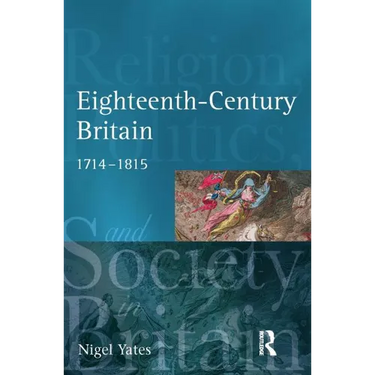


Eighteenth-Century Britain: Religion and Politics, 1714-1815 - Paperback
 Eighteenth-Century Britain: Religion and Politics, 1714-1815 - Paperback
$120.38
/
Eighteenth-Century Britain: Religion and Politics, 1714-1815 - Paperback
$120.38
/

products.product.pickup_availability.unavailable

Your payment information is processed securely. We do not store credit card details nor have access to your credit card information.


by Nigel Yates (Author)
By 1714 Britain was still reeling from the major religious upheavals of the previous two centuries. In this essential new study Nigel Yates introduces us to this uncertain time where religion remained at the very heart of British life while new and radical ideas were beginning to appear below the surface. Based on original research by the author and the most up-to-date literature this is an essential guide to Britain in 1714 to 1815, a period in which the first truly religiously diverse society in Europe developed.
Back Jacket
Religion, Politics and Society in Britain 1714-1815
Nigel Yates
Praise for the series after the first three volumes published in 2006:
"On the basis of these books, this will prove a most promising series intellectually, as well as one that offers much to students."
Jeremy Black, Exeter University, "Times Higher Educational Supplement"
By 1714 Britain was still reeling from the major religious upheavals of the previous two centuries. In this essential new study Nigel Yates introduces us to this uncertain time where religion remained at the very heart of British life while new and radical ideas were beginning to appear below the surface.
Yates explores the dynamic of the established churches' roles in the social and political life of eighteenth century Britain. He finds that during this time the Anglican Church in England, Ireland and Wales and the Presbyterians of Scotland were an integral part of the system of government- an arrangement which was staunchly defended by churchmen and politicians alike.
From private devotion to land and property, from high politics to the family and sexuality, the church was a potent force in the minds and hearts of virtually every individual living in Britain and Ireland.
However, the seeds of change were being sown. New denominations began to gain recognition and major theological movements such as liberalism and evangelicalism and ultimately the move towards secularism all have their origins in this era. Much earlier than other European countries, Britain was becoming a religiously pluralist society.
Based on original research by the author and the most up-to-date literature this is an essential guide to Britain in 1714 to 1815, a period in which the first truly religiously diverse society in Europe developed.
This essential guide includes:
- Brief biographies of all the main religious leaders
- A list of churches and chapels containing largely unaltered interiors/furnishings of the period
- A detailed guide to further reading
Nigel Yates is one of the leading historians of religion in Britain and Europe during the eighteenth and nineteenth centuries. Over the past thirty years he has published widely in this field. His publications include: "The Religious Condition of ""Ireland""1770-1850" (2006); "Anglican Ritualism in Victorian ""Britain""1830-1910" (1999) and "Buildings, Faith and Worship: the Liturgical Arrangement of Anglican Churches 1600-1900" (1991, 2000)
Author Biography
Nigel Yates is a Professor of Ecclesiastical History, University of Wales, Lampeter and is also is currently Provincial Archives Advisor to the Church in Wales. A leading historian of the period, he has published widely on Britainand Europe in the eighteenth and nineteenth centuries. He has particular expertise on the history of church buildings and was a member of the Executive Committee of the Church of England's Council for the Care of Churches. As an archivist with a special knowledge of church records, he served as Diocesan Archivist to the Archbishop of Canterbury and the Bishops of Portsmouthand Rochester. He was also a member of the General Synod of the Church of England's Archives Advisory Committee.

