
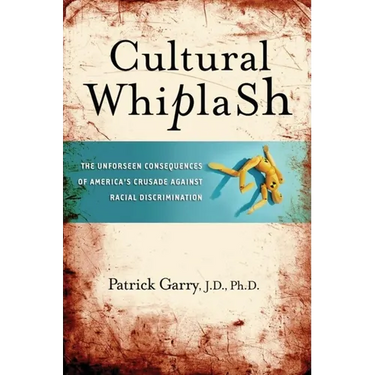

Cultural Whiplash: The Unforeseen Consequences of America's Crusade Against Racial Discrimination - Hardcover
 Cultural Whiplash: The Unforeseen Consequences of America's Crusade Against Racial Discrimination - Hardcover
$36.99
/
Cultural Whiplash: The Unforeseen Consequences of America's Crusade Against Racial Discrimination - Hardcover
$36.99
/

products.product.pickup_availability.unavailable

Your payment information is processed securely. We do not store credit card details nor have access to your credit card information.


by Patrick Garry (Author)
Law professor Patrick Garry believes today's racial problem is not silence, but rather confusion. Accusations of racism are vague but pervasive. They have become an indictment against the very legitimacy of society as a whole. With that has come a suffocating social guilt, and that sense of guilt has resulted in a steady retreat from moral and value judgments on all cultural matters, not just those of race. Garry addresses racism in America from the perspective of the cultural majority, unlike most books on the subject that focus on issues that are important to the victims of racism. Garry instead examines how whites have allowed themselves to be marginalized in the conversation on race, how the fear of being labeled a racist has resulted in whites withdrawing from any dialogue or moral judgment involving almost all cultural matters, and how racial fear and guilt are influencing the moral health of America.
Back Jacket
In public and private circles, the mere mention of race of the charge of racism generates a predictable response: silence. In Cultural Whiplash, law professor Patrick Garry examines how this has come to pass. In particular, he explores the negative fallout of the antidiscrimination movement as it has evolved since the 1950s and '60s.
During the civil rights era, racial discrimination was easy to spot. In some communities, laws made it difficult for minorities to vote or get decent jobs, enforced segregated schools, and denied minority students admission to many colleges and universities. Today, the racial climate is much different. Now people fear offending others through "subtle, subconscious, or invisible racism" that cannot be detected without "assistance."
In this context, Garry views confusion as today's greatest racial problem, not silence. Accusations of racism have become so vague and so pervasive that the moral authority that defines our society is gradually blurred and confused. The suffocating social guilt that results has caused a steady retreat from moral and value judgments on all cultural matters, not just those relating to race.
With all the energy devoted to race and racism over recent decades, we should have a more racially harmonious society. But the opposite is true. So many fear being branded as racists that--even in the wake of the 9/11 attacks--the nation is fragmented and fractured into a multitude of self-interest groups that have little or no concern about what is good for all. And the situation is only made worse by groups that employ charges of racism as a potent weapon in a larger political crusade that transcends race.
Patrick Garry addresses racism from the perspective of the cultural majority, unlike most books on the subject that focus only on issues relating to the victims of racism. He discusses a variety of issues, including culture, illegal immigration, dress codes, unemployment, educational standards, arrest rates, lending practices, career advancement, affirmative action, and reparations. In the last instance, Garry believes that nothing feeds of white guild more than the reparations movement, even though most of the modern-day problems in the African American community can be traced to the Great Society programs of the 1960s. Yet he ponders if some form of reparations may be in order if we are to move beyond the status quo and end the endless accusations and discriminatory practices of affirmative action--the very policies of racial segregation against which Dr. Martin Luther King Jr. campaigned so valiantly.

