
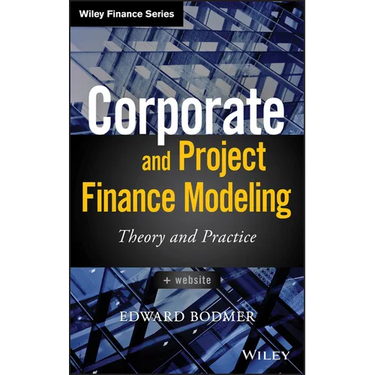

Corporate and Project Finance Modeling: Theory and Practice - Hardcover
 Corporate and Project Finance Modeling: Theory and Practice - Hardcover
$75.00
/
Corporate and Project Finance Modeling: Theory and Practice - Hardcover
$75.00
/

products.product.pickup_availability.unavailable

Your payment information is processed securely. We do not store credit card details nor have access to your credit card information.


by Edward Bodmer (Author)
A clear and comprehensive guide to financial modeling and valuation with extensive case studies and practice exercises
Corporate and Project Finance Modeling takes a clear, coherent approach to a complex and technical topic. Written by a globally-recognized financial and economic consultant, this book provides a thorough explanation of financial modeling and analysis while describing the practical application of newly-developed techniques. Theoretical discussion, case studies and step-by-step guides allow readers to master many difficult modeling problems and also explain how to build highly structured models from the ground up. The companion website includes downloadable examples, templates, and hundreds of exercises that allow readers to immediately apply the complex ideas discussed.
Financial valuation is an in-depth process, involving both objective and subjective parameters. Precise modeling is critical, and thorough, accurate analysis is what bridges the gap from model to value. This book allows readers to gain a true mastery of the principles underlying financial modeling and valuation by helping them to:
- Develop flexible and accurate valuation analysis incorporating cash flow waterfalls, depreciation and retirements, updates for new historic periods, and dynamic presentation of scenario and sensitivity analysis;
- Build customized spreadsheet functions that solve circular logic arising in project and corporate valuation without cumbersome copy and paste macros;
- Derive accurate measures of normalized cash flow and implied valuation multiples that account for asset life, changing growth, taxes, varying returns and cost of capital;
- Incorporate stochastic analysis with alternative time series equations and Monte Carlo simulation without add-ins;
- Understand valuation effects of debt sizing, sculpting, project funding, re-financing, holding periods and credit enhancements.
Front Jacket
Corporate and Project Finance Modeling is a comprehensive guidebook for creating, interpreting, and analyzing complex financial models. The book offers the information needed to master difficult modeling problems and shows how to build highly structured models from the ground up. Using the suggestions and techniques outlined in this important text, beginners and experienced professionals can hone their skills and take their performance to the next level in order to analyze and create flexible, efficient, and stable model structures.
Edward Bodmer, an international expert in the field, covers the technical aspects of building and analyzing financial models and presents results from a wide range of alternative models. To gain a clear understanding of the process, the author reveals why particular modeling features are generally included in one kind of model but not in others.
The book also introduces unique modeling techniques that address many complex issues that are not typically used by even the most experienced modelers. For example, the author shows how to build user-defined functions to solve circular logic without cumbersome copy and paste macros. The book explains how to derive ratios of enterprise value to earnings before interest, taxes, depreciation, and amortization (EV/EBITDA) that account for asset life, historical growth, taxes, return on investment, and cost of capital.
In addition to explaining how to solve a modeling problem, Corporate and Project Finance Modeling explores the finance theory underlying how to construct models with an exact approach. The author addresses modeling issues ranging from the fundamental structure of financial models to the creation of user-defined VBA functions that resolve circular references. Each issue covered includes a theoretical discussion and an explanation of the modeling mechanics as applied to various corporate structures. The book covers a wide range of vital topics including a review of valuation in the context of project finance, corporate finance, and acquisition finance; cash flow waterfalls; credit analysis in corporate and project finance; debt structuring; determination of items that should be in the bridge between enterprise value and equity value; and many other subjects. To enhance the text, the modeling problems are explained with illustrative diagrams and screen shots from actual models.
This comprehensive text includes a companion website that contains exercises, model examples, video explanations, and case studies.
Designed as a flexible resource, Corporate and Project Finance Modeling gives professionals the information needed to borrow subtle concepts from solutions to many different modeling problems so they can apply them to their own models.
Back Jacket
Corporate and Project Finance Modeling is a comprehensive guidebook for creating, interpreting, and analyzing complex financial models. The book offers the information needed to master difficult modeling problems and shows how to build highly structured models from the ground up. Using the suggestions and techniques outlined in this important text, beginners and experienced professionals can hone their skills and take their performance to the next level in order to analyze and create flexible, efficient, and stable model structures.
Edward Bodmer, an international expert in the field, covers the technical aspects of building and analyzing financial models and presents results from a wide range of alternative models. To gain a clear understanding of the process, the author reveals why particular modeling features are generally included in one kind of model but not in others.
The book also introduces unique modeling techniques that address many complex issues that are not typically used by even the most experienced modelers. For example, the author shows how to build user-defined functions to solve circular logic without cumbersome copy and paste macros. The book explains how to derive ratios of enterprise value to earnings before interest, taxes, depreciation, and amortization (EV/EBITDA) that account for asset life, historical growth, taxes, return on investment, and cost of capital.
In addition to explaining how to solve a modeling problem, Corporate and Project Finance Modeling explores the finance theory underlying how to construct models with an exact approach. The author addresses modeling issues ranging from the fundamental structure of financial models to the creation of user-defined VBA functions that resolve circular references. Each issue covered includes a theoretical discussion and an explanation of the modeling mechanics as applied to various corporate structures. The book covers a wide range of vital topics including a review of valuation in the context of project finance, corporate finance, and acquisition finance; cash flow waterfalls; credit analysis in corporate and project finance; debt structuring; determination of items that should be in the bridge between enterprise value and equity value; and many other subjects. To enhance the text, the modeling problems are explained with illustrative diagrams and screen shots from actual models.
This comprehensive text includes a companion website that contains exercises, model examples, video explanations, and case studies.
Designed as a flexible resource, Corporate and Project Finance Modeling gives professionals the information needed to borrow subtle concepts from solutions to many different modeling problems so they can apply them to their own models.
Author Biography
EDWARD BODMER is an experienced financial and economic consultant, trainer, and lecturer. He has conducted many training programs around the world to both large corporations and public programs that have covered project finance, corporate finance, energy analysis, and mergers and acquisitions. Formerly, Bodmer was the Vice President at the First National Bank of Chicago, where he directed analysis of energy loans and also created financial modeling techniques used in advisory projects.

