
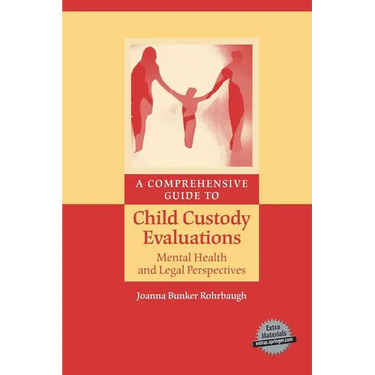

A Comprehensive Guide to Child Custody Evaluations: Mental Health and Legal Perspectives - Paperback
 A Comprehensive Guide to Child Custody Evaluations: Mental Health and Legal Perspectives - Paperback
$168.98
/
A Comprehensive Guide to Child Custody Evaluations: Mental Health and Legal Perspectives - Paperback
$168.98
/

products.product.pickup_availability.unavailable

Your payment information is processed securely. We do not store credit card details nor have access to your credit card information.


by Joanna Bunker Rohrbaugh (Author)
Mental health professionals are now frequently asked to offer opinions regarding child custody and visitation issues. In formulating a recommendation, the evaluator analyzes family dynamics and their effect on the child. This comprehensive guide provides brief summaries of the various legal issues, social science research, and assessment procedures involved in court-ordered evaluations of children and families. It also contains guidelines for performing child custody evaluations for the family courts, along with brief summaries of the related social science research and legal criteria. Coverage incorporates discussion of the laws and the specific issues, including sexual orientation, mental illness, substance abuse, violence and physical abuse. It also offers samples of child custody cases.
Back Jacket
Whether assessing general family functioning or specific areas of conflict, professionals ordering, conducting, or reviewing child custody evaluations require sound knowledge of three interrelated fields: up-todate legal issues, psychological findings, and forensic procedures. A Comprehensive Guide to Child Custody Evaluations covers these three essential areas to walk readers through the evaluation process clearly and concisely. This unique interdisciplinary book emphasizes professional ethics, children's psychological well-being, and clear communication among all parties as keys to resolving disputes with efficiency and thoroughness, and minimizing the chances of children and their families getting lost in red tape.
Among the Guide's features:
- Legal standards for custody evaluations and recommendations.
- Procedures for conducting custody evaluations, with the latest data on psychological testing, interviewing children, and home observations.
- Guidelines for writing: evaluation reports, orders for evaluations, parenting plans.
- Legal and ethical standards for critiquing evaluation reports.
- Current legal and research-based information on special issues, including alternative family arrangements, medical problems, child sexual abuse, estrangement, and parental abduction.
- Reference and resource sections provide additional support.
The Guide's interdisciplinary approach will be of invaluable aid to forensic mental health professionals in conducting evaluations and communicating results, family and probate judges in ordering and assessing custody evaluations, and family attorneys in deciding how to approach various aspects of the family situation, whether to request a custody evaluation, and how to proceed after the custody evaluation is done.
Author Biography
Joanna Bunker Rohrbaugh, Ph.D. is a trauma specialist who has been on the faculty of the Harvard Medical School for over twenty years, and is a clinical supervisor for the Victims of Violence and other outpatient programs at Cambridge Hospital. She holds a B.A. from Brown University and a Ph.D. in Personality and Developmental Psychology from Harvard University. Dr. Rohrbaugh has a private forensic psychology practice in Cambridge, MA, where she does child custody evaluations, parenting/bonding evaluations, and forensic consultation, and also serves as a child expert and a divorce coach in collaborative law cases.
Dr. Rohrbaugh is a member of the Board of Directors of the Massachusetts Chapter of the Association of Family and Conciliation Courts (AFCC) and a former board member of the Massachusetts Association of Guardians Ad Litem (MAGAL). Her family forensic experience includes Custody and Visitation, Care and Protection, Adoption, Child Estrangement/Alienation, Domestic Violence, Sexual Orientation, Physical Abuse of Child, PTSD, Sexual Abuse of Children, Substance Abuse, Removal, and Termination of Parental Rights.

