

BooksCloudSKU: 9798354669004
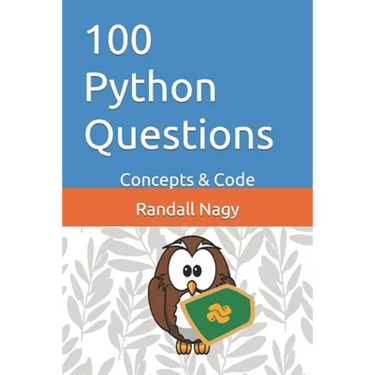
100 Python Questions: Concepts & Code - Paperback
$40.73
/
Shipping calculated at checkout.
In stock (50)
$40.73
 100 Python Questions: Concepts & Code - Paperback
$40.73
/
100 Python Questions: Concepts & Code - Paperback
$40.73
/

100 Python Questions: Concepts & Code - Paperback
$40.73
/
products.product.pickup_availability.unavailable
Still deciding?

Payment & Security
Your payment information is processed securely. We do not store credit card details nor have access to your credit card information.
Security
Related categories


High-Quality MaterialsMade with premium materials for long-lasting use.
Easy to UseSimple design for quick setup and convenience.
Versatile & Multi-PurposePerfect for home, office, or on-the-go.
Satisfaction GuaranteeLove it or return it for a full refund.
by Colin Nagy (Contribution by), Evan Nagy (Contribution by), Randall Nagy (Author)
Python Interview Questions & Concepts is designed for beginner, intermediate, as well as advanced students. The purpose of this book is to allow us to:
- Rapidly learn advanced concepts by minimizing non-technical discourse
- Prepare for job interviews as quickly as possible
- Resurrect what we know, but may not have used for a while
- Serve as the answer key to the new flash-card deck and card game
Updated to 100 Q&A case studies this second edition of Python Interview Questions & Concepts combines the content of PyQuest Beginner, PyQuest Advanced, 35 additional PyQuest Intermediate concepts as well as 5 more PyQuest Beginner questions, answers, and code demonstrations. The updated set of PyQuest cards are part of the companion PyQuest card deck, game, and flashcard book. The question & answer case studies in this book include: KA1001: The Whole Shebang
KA1002: The REPL
KA1003: Common Data Types
KA1004: Common Object Types
KA1005: Common Object Content
KA1006: Collection Sizes
KA1007: Immutable Collections
KA1008: Mutable Tuples
KA1009: Object Identification
KA1010: Mutable Lists
KA1011: Sorting Basics
KA1012: Reverse Sorting Basics
KA1013: Key-Value Pairs
KA1014: Sorting Dictionaries
KA1015: Dictionary Orderings
KA1016: Dictionary Changes
KA1017: Dictionary Removal
KA1018: List Removal
KA1019: List Sorting
KA1020: Merging Collections
KA1021: Zero-Based Access
KA1022: Key-Index Default
KA1023: Function Default
KA1024: Function Parameters
KA1025: Using *arg
KA1026: Using **kwargs
KA1027: Common *arg & **kwargs
KA1028: Slicing Range
KA1029: The 'with' Keyword
KA1030: The 'yield' Keyword
KA1031: Set -v- Dictionary
KA1032: Set Creation
KA1033: Set Differences
KA1034: Docstring
KA1035: Doctest Basics
KA2001: Exceptions
KA2002: Exceptional Keywords
KA2003: Assertions
KA2004: Class Basics
KA2005: Basic Inheritance
KA2006: Class Construction Basics
KA2007: Private Membership
KA2008: Protected Membership
KA2009: Is-A Relationships
KA2010: Has-A Relationship
KA2011: Overriding
KA2012: Encapsulation
KA2013: Properties
KA2014: Class Representation
KA2015: Framework Basics
KA2016: Base Classes
KA2017: Polymorphism
KA2018: Keyword Conflicts
KA2019: REPL Underscore
KA2020: Coding Standards
KA2021: Code Evaluation
KA2022: Length Evaluation
KA2023: Anonymous Evaluations
KA2024: Lambda Functions
KA2025: String Formatting
KA2026: String Formatting
KA2027: Unicode
KA2028: Zip
KA2029: Enumeration
KA2030: Range -v- Enumerate
KA2031: The 'is' Keyword
KA2032: The 'or' Keyword
KA2033: The 'and' Keyword
KA2034: Set Comprehension
KA2035: Dict Comprehension
KA3001: Dunder Functions
KA3002: Wheel File
KA3003: exec()
KA3004: Using *args & **kwargs
KA3005: Iterable Types
KA3006: Limiting Class Variables
KA3007: Function Name Management
KA3008: Function Call Management
KA3009: Function Call Detection
KA3010: Deep Copy
KA3011: Copy Management
KA3012: Shallow Copy Management
KA3013: Deep Copy Management
KA3014: Directed Copy Management
KA3015: Default Copy Management
KA3016: Instance Management
KA3017: Object Destruction
KA3018: Deletion Caveat
KA3019: Function Decoration
KA3020: Creation Decorators
KA3021: Static Construction
KA3022: @classmethod -v- new
KA3023: Static Methods
KA3024: Object Construction
KA3025: Object Factories
KA3026: Duck Typing
KA3027: Duck Typing Caveats
KA3028: Abstract Functions
KA3029: Signature Assurance
KA3030: Static Member Assurance
Number of Pages: 362
Dimensions: 0.75 x 9 x 6 IN
Publication Date: October 03, 2022
Free shipping on all U.S. orders
Easy returns and exchanges
30 day money back guarantee

