
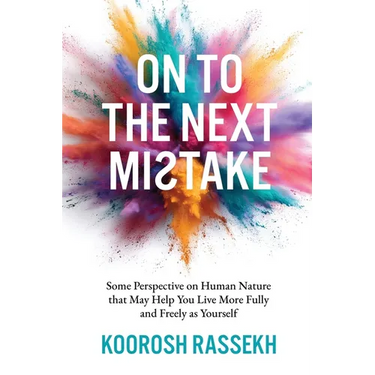


Onto the Next Mistake: Some Perspective on Human Nature that May Help You Live More Fully and Freely as Yourself - Paperback
 Onto the Next Mistake: Some Perspective on Human Nature that May Help You Live More Fully and Freely as Yourself - Paperback
$34.00
/
Onto the Next Mistake: Some Perspective on Human Nature that May Help You Live More Fully and Freely as Yourself - Paperback
$34.00
/

products.product.pickup_availability.unavailable

Your payment information is processed securely. We do not store credit card details nor have access to your credit card information.


by Koorosh Rassekh (Author)
What if everything you've been made to think is evidence of something wrong with you is evidence of something right?
We live in a world that is quick to label us: disordered, anxious, depressed, addicted. We are taught to see our struggles as signs of what's broken within us-evidence that something has gone wrong.
But what if those struggles are not evidence of dysfunction, but of adaptation? What if they are the ways we learned-often very early in life-to survive?
Imagine a sapling growing in the shade of a large tree, bending and stretching toward the light in whatever way it can. We don't look at that tree and call it flawed. We understand it is doing exactly what it must to live.
What if we are no different?
In this deeply human and thought-provoking book, therapist Koorosh Rassekh offers a radically compassionate reframe of human nature, mental health, and what we've been taught to call "disorder." Drawing on his own lived experience as well as his work with clients both inside and outside traditional mental health, he challenges the inherited rules about what is normal, healthy, and acceptable.
He invites us to wonder alongside him: What's abnormal? What's unhealthy? And who decides?
Through story, reflection, and clinical insight, Rassekh invites us to question the labels we've been given and the stories we've learned to tell about ourselves. He offers a different possibility: that the patterns we struggle with are not signs of failure, but expressions of deep inner wisdom-evidence of how we adapted to survive.
This is not a book about fixing yourself. It is an invitation to see yourself differently.
To move from asking What's wrong with me? to wondering, perhaps for the first time:
What if nothing about me is fundamentally wrong?
What if everything I've been told is evidence of something wrong with me is evidence of something right?

